Cloud Data Security · Topic 5 of 7
Information Rights Management
CCSP information rights management: persistent data rights, provisioning, access models, certificate issuing and revocation, and IRM limits in cloud.
- 5 min
- Includes a diagram
- IRM protection is persistent: it travels with the file.
- Key capabilities: data rights, provisioning, access models, dynamic policy, expiration, revocation, audit trail.
- IRM is built on PKI; certificates and licences must be issued after authentication and be revocable.
What it is
Information rights management (IRM), also called digital rights management for enterprise content, protects a file wherever it goes. The file is encrypted and carries a policy that says who may open it and what they may do: view, edit, print, copy, forward, and for how long.
Unlike access control on a storage location, IRM protection travels with the data. A file emailed outside the company, or copied to a personal cloud folder, stays locked.
How it works
Objectives
| Objective | Meaning |
|---|---|
| Data rights | Fine grained permissions on the content: view, edit, print, copy, screen capture, forward |
| Provisioning | Granting rights to users and groups, ideally from the central identity system |
| Access models | How rights are decided: by user, group, role, attributes, or by the document's classification |
| Persistent protection | Rights stay with the file in any location |
| Dynamic policy control | Owners can change rights after the file has been shared |
| Expiration | Access ends on a set date |
| Remote revocation | Rights can be withdrawn so the file can no longer be opened |
| Continuous audit trail | Every open and action attempt is logged |
How IRM is built
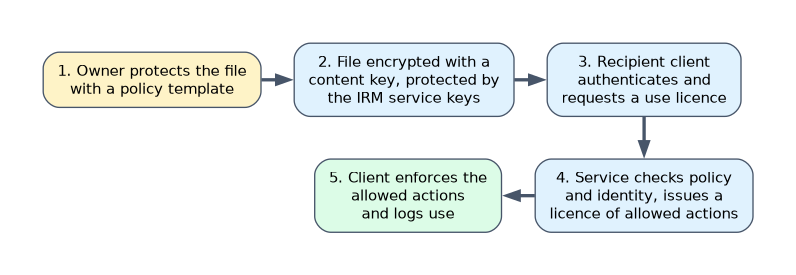 IRM uses public key infrastructure. The IRM service issues certificates that bind users and devices to keys, encrypts content keys for authorized users, and checks policy each time a file is opened.
- The owner protects a document using a policy template, often tied to a classification label.
- The document is encrypted with a content key, which is protected by the IRM service's keys.
- A recipient's client authenticates and requests a use licence.
- The service checks the policy and the recipient's identity, then issues a licence listing allowed actions.
- The client enforces those actions and logs use.
Issuing and revocation of certificates
Appropriate IRM tools must handle the full credential lifecycle:
- Issuing: certificates or licences are issued only after authentication, with identities from the organization's IdP or a federated partner.
- Renewal: short lived licences force regular rechecks, so changed policies take effect.
- Revocation: when a user leaves or a device is lost, its certificate is revoked and new licences are refused.
Revocation only works when the client must contact the service. Offline access windows trade convenience for slower revocation.
Access models compared
| Model | Example policy |
|---|---|
| User or group | Only the finance group may open the budget |
| Role based | Auditors may view, never edit |
| Attribute based | Readable only from managed devices in approved countries |
| Classification driven | Every Restricted document gets view only, no print, 30 day expiry |
Classification driven templates scale best, because users simply label the document and the correct rights follow.
Limits and challenges
- Client requirement: recipients need a compatible application, agent or plug in; unsupported formats cannot be protected.
- Analog hole: someone can still photograph a screen; IRM deters and records, it does not make leakage impossible.
- Partners: external users need identities the IRM service trusts, often through federation.
- Search and processing: encrypted files cannot be indexed or scanned by services without rights, including some DLP and eDiscovery tools.
- Key availability: if the IRM service or its keys are lost, protected files become unreadable.
IRM and DLP together
DLP detects and blocks sensitive data moving where it should not. IRM keeps data protected after it has moved. Many organizations let DLP apply IRM automatically to sensitive files leaving through approved channels.
A worked example
A pharmaceutical company shares trial results with three external research partners through a SaaS file service. It needs partners to read but not print or forward the files, and to cut off access when the study ends.
The company federates partner identities, applies an IRM template "Trial partner: view only, no print, no forward, expires at study end", and sets licences to renew daily. When one partner's contract ends early, its users' rights are revoked, and their next open attempt fails even on copies already downloaded.
How the exam asks about this
- "Which control continues to protect a document after it has been emailed outside the organization?" Information rights management.
- "What IRM capability lets an owner withdraw access to files already shared?" Remote rights revocation, through dynamic policy control.
- "What is a common limitation of IRM?" Recipients need compatible client software, and it cannot stop photographs of a screen.
What to remember for the exam
- IRM protection is persistent: it travels with the file.
- Key capabilities: data rights, provisioning, access models, dynamic policy, expiration, revocation, audit trail.
- IRM is built on PKI; certificates and licences must be issued after authentication and be revocable.
- Classification driven templates make IRM usable at scale.
- IRM needs compatible clients and does not defeat the analog hole.
Long offline access windows weaken revocation. A user whose rights were withdrawn can keep opening files until the cached licence expires.
Common mistakes
Confusing IRM with access control on storage. Folder permissions stop at the folder; IRM rights follow the file.
Expecting IRM to prevent all leakage. It controls actions in supported software and logs use, but a determined insider can still photograph content.
Forgetting external identities. Without federation or partner accounts, IRM blocks the very partners it was meant to serve.
Check yourself
What makes IRM different from DLP?
DLP detects and stops sensitive data moving where it should not, while IRM keeps protecting the content and enforcing rights after it has moved.
Why are short licence lifetimes useful in IRM?
They force regular rechecks with the IRM service, so policy changes and revocations take effect quickly.
Which technology does IRM rely on to bind users to keys?
Public key infrastructure, through certificates issued and revoked by the IRM service.
Topic 5 of 7 in Cloud Data Security
Test yourself on Cloud Data Security
The full ISC2 CCSP question bank has 900 questions, with timed practice exams and an explanation for every answer.
This study guide is independent and is not affiliated with, endorsed by, or sponsored by ISC2. Vendor names, certification names and exam codes are trademarks of their respective owners and are used for identification only.