Governance · Topic 5 of 7
Enterprise Risk Management and Lines of Defense
CRISC ERM and lines of defense: how IT risk fits enterprise risk, COSO ERM 2017, ISO 31000, and the IIA Three Lines Model roles for the risk practitioner.
- 5 min
- Includes a diagram
- IT risk is part of ERM and must use the enterprise taxonomy, scales and appetite.
- COSO ERM 2017 has five components and 20 principles, with governance and culture first.
- ISO 31000:2018 risk assessment is identification, analysis and evaluation.
What it is
Enterprise risk management (ERM) manages all of an organization's risks together: strategic, financial, operational, compliance and technology. IT risk is one category inside ERM, not a separate silo, so it must be expressed in the same language and fed into the same profile.
The lines of defense model, now framed by the IIA as the Three Lines Model (2020), describes who manages risk, who oversees it and who gives independent assurance.
How it works
Why integrate IT risk into ERM
When IT risk is managed separately, leaders cannot compare it with other risks or see how a technology failure drives financial, legal and reputational loss. Integration means using the enterprise risk taxonomy, the same rating scales and the same appetite, and rolling IT risks into the enterprise risk profile. The job practice asks the practitioner to maintain the IT risk register and incorporate it into this enterprise-wide view.
ERM frameworks
| Framework | Key structure |
|---|---|
| COSO ERM (2017) "Integrating with Strategy and Performance" | Five components: Governance and Culture; Strategy and Objective-Setting; Performance; Review and Revision; Information, Communication, and Reporting. 20 principles. |
| ISO 31000:2018 | Principles, framework and process. Process: scope, context and criteria; risk assessment (identification, analysis, evaluation); treatment; monitoring and review; communication and consultation; recording and reporting. |
| ISACA Risk IT Framework | Applies these ideas to IT risk and aligns with COBIT 2019, covering risk governance, risk evaluation and risk response. |
COSO ERM stresses that risk should inform strategy setting, not just operations. ISO 31000 stresses that risk management is part of all activities and must be tailored to the organization.
The ERM cycle
A typical ERM cycle sets context and appetite, identifies and assesses risks, chooses responses, monitors and reports, then reviews and improves. The cycle repeats, because the business and threats keep changing.
The Three Lines Model
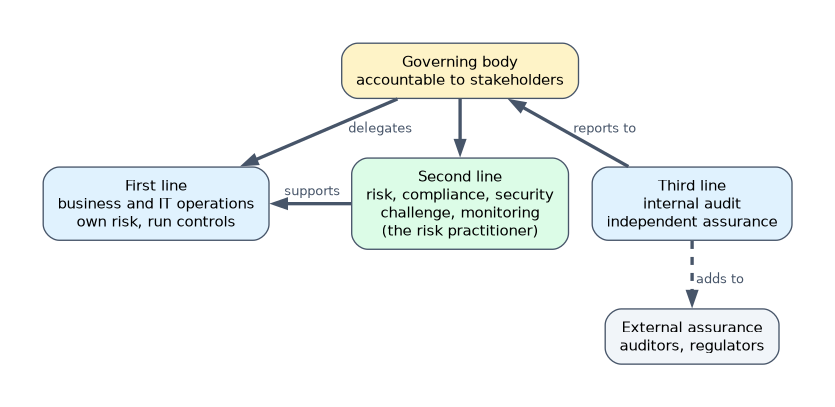 The IIA's 2020 update replaced the older "three lines of defense" wording with a principles-based model of roles. The governing body is accountable to stakeholders; management takes first and second line roles; internal audit takes the third line role; and external assurance providers add further assurance.
| Line | Who | Role in IT risk |
|---|---|---|
| First line | Business and IT operations management | Owns and manages risk, runs controls day to day |
| Second line | Risk management, compliance, information security oversight | Provides expertise, frameworks, challenge and monitoring |
| Third line | Internal audit | Independent, objective assurance to the board |
| External | External auditors, regulators | Further independent assurance |
The risk practitioner usually works in the second line: setting methods, facilitating assessments, challenging ratings and reporting. The practitioner supports the first line but does not take over its ownership of risk.
Independence
The third line must stay independent. If internal audit designs controls or manages risk, it cannot then give objective assurance over them. The second line also needs enough independence from the first line to challenge it credibly.
A worked example
A manufacturer keeps its IT risk register in a separate tool with a five-point scale, while ERM uses a four-point scale and different impact categories. The board sees a top ten enterprise risk list with no technology risks, even though a plant control system outage would stop production.
The practitioner maps IT risk impacts to the enterprise categories, aligns the scales and submits the plant system risk through the ERM process. It enters the enterprise profile as an operational risk with a technology cause, so the board can compare it with other risks.
How the exam asks about this
- "What is the MOST important benefit of integrating IT risk into ERM?" Senior management can compare IT risk with other enterprise risks and prioritize consistently.
- "Which function provides independent assurance over the risk management program?" Internal audit, the third line.
- "Who is PRIMARILY responsible for managing risk in day to day operations?" First line management, the business and IT operations that own the activities.
What to remember for the exam
- IT risk is part of ERM and must use the enterprise taxonomy, scales and appetite.
- COSO ERM 2017 has five components and 20 principles, with governance and culture first.
- ISO 31000:2018 risk assessment is identification, analysis and evaluation.
- First line owns and manages; second line oversees and challenges; third line gives independent assurance.
- The risk practitioner normally sits in the second line.
Internal audit loses its independence if it designs or runs the controls it later audits. Options that give the third line ownership of risk or controls are wrong.
Common mistakes
Running IT risk as a separate program. Separate scales and categories stop leaders from seeing technology risk alongside other enterprise risks.
Thinking the second line owns risk. The second line advises and challenges; the first line remains accountable.
Using the old "defense" wording as if it were rigid. The 2020 model focuses on roles and collaboration, not strict walls between lines.
Check yourself
Why should the IT risk register feed the enterprise risk profile?
So technology risks are seen, compared and prioritized alongside other enterprise risks using the same scales and appetite.
Which line does the risk practitioner usually belong to, and what does it do?
The second line, which provides frameworks, expertise, monitoring and challenge to the first line that owns the risk.
What are the three steps of risk assessment in ISO 31000:2018?
Risk identification, risk analysis and risk evaluation.
Topic 5 of 7 in Governance
Test yourself on Governance
The full ISACA CRISC question bank has 1,000 questions, with timed practice exams and an explanation for every answer.
This study guide is independent and is not affiliated with, endorsed by, or sponsored by ISACA. Vendor names, certification names and exam codes are trademarks of their respective owners and are used for identification only.