AI Operations · Topic 4 of 8
Supervision of AI Outputs, Impacts and Decisions
Auditing AI supervision: human oversight models, output monitoring, KPIs and KRIs, drift and fairness metrics, explainability, appeals and automation bias.
- 5 min
- Includes a diagram
- In the loop, on the loop and out of the loop: match oversight to risk.
- Near-zero overrides suggest automation bias, not perfection.
- Every metric needs a threshold, owner and action.
What it is
Supervision is how the organization watches an AI system once it is live: its outputs, the decisions taken from them and their impact on people and the business. It combines human oversight of individual decisions with monitoring of performance over time.
The auditor evaluates the role and impact of AI decision-making and the monitoring and reporting of metrics such as KPIs and KRIs. A model that passed every test at release can still fail later, so supervision is where most production problems are caught or missed.
How it works
Levels of human oversight
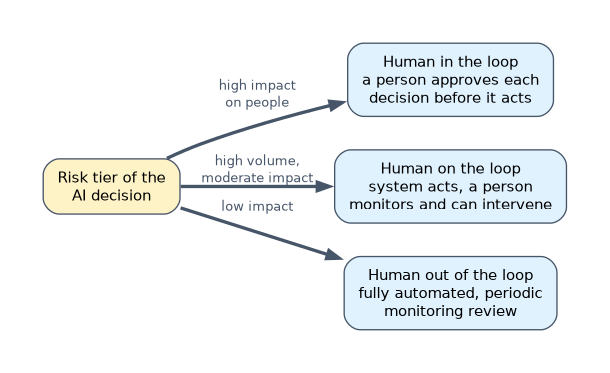
| Model | Meaning | Typical use |
|---|---|---|
| Human in the loop | A person approves each decision before it takes effect | High-impact decisions about people |
| Human on the loop | The system acts; a person monitors and can intervene | High volume, moderate impact |
| Human out of the loop | Fully automated, reviewed through periodic monitoring | Low impact |
The level should follow the risk tier and any legal requirement. The auditor checks that reviewers have the authority, time, training and information to disagree with the AI.
Automation bias
Automation bias is the tendency to accept AI output without real scrutiny. A reviewer who approves 2,000 recommendations a day is not providing oversight. Evidence of real oversight includes override rates, time spent per review, and reviewer comments.
An override rate near zero is a warning sign, not proof of a perfect model. The auditor can test it by sampling decisions and checking whether reviewers had enough information to judge.
Metrics: KPIs and KRIs
| Type | Examples for AI |
|---|---|
| KPIs (performance) | Accuracy, precision and recall against target, processing time saved, customer satisfaction, adoption |
| KRIs (risk) | Drift indicators, fairness gap between groups, override rate, complaint and appeal volumes, fabricated answer rate, incidents, models overdue for review |
Each metric needs a threshold, an owner and a defined action when breached. The auditor evaluates whether metrics are accurate, reported to the right level and acted on. A dashboard nobody reviews is not a control.
Monitoring for drift and degradation
Monitoring compares production behaviour with the validated baseline. Because true outcomes often arrive late (a loan default appears months later), monitoring uses leading indicators such as input distribution changes and output rate shifts, then confirms with outcome data when it arrives.
Fairness and impact monitoring
Bias can appear after deployment as the population changes. Outcomes should be monitored by relevant group, with a defined fairness threshold. Complaints and appeals are also impact signals and should feed into model review.
Explainability and contestability
People affected by AI decisions may need an explanation and a way to challenge the result. The auditor checks that explanations exist at the level required, are consistent with the model's actual drivers, and that appeals reach a person who can change the outcome.
Logging
Decision logs should record the input, model version, output, any human review and the final decision. Without logs, the organization cannot investigate complaints, reconstruct incidents or demonstrate compliance. For generative AI, logging prompts and responses must be balanced with privacy, so retention and access need rules.
Periodic review
High-risk models need scheduled revalidation, even if metrics look fine. The review asks whether the model still fits its purpose, data and regulatory context.
A worked example
An insurer uses AI to recommend claim payouts, with adjusters approving each one. The KPI dashboard shows high accuracy. The auditor samples 60 approvals: adjusters accepted all 60 within an average of 40 seconds, and the system showed them only the recommended amount, not the reasons.
The auditor concludes that human-in-the-loop oversight is designed but not effective. The recommendation is to show adjusters the key factors, monitor override rates and set review time expectations.
How the exam asks about this
- "Which is the BEST indicator that human oversight of AI decisions is effective?" Override and challenge rates, supported by evidence that reviewers had the information and authority to disagree.
- "Monitoring shows input data has shifted, but outcomes are not yet known. What should happen FIRST?" Investigate the drift against thresholds and escalate per the monitoring procedure before outcome data confirms harm.
- "Which metric is a KRI rather than a KPI for an AI system?" The fairness gap between groups, the drift indicator or the complaint rate.
What to remember for the exam
- In the loop, on the loop and out of the loop: match oversight to risk.
- Near-zero overrides suggest automation bias, not perfection.
- Every metric needs a threshold, owner and action.
- Monitor fairness by group after deployment, not just at release.
- Decision logs must include the model version.
A human reviewer who cannot see why the AI recommended something, or has no time to check, provides the appearance of oversight only. Test the reviewer's information and authority, not just the existence of a sign-off.
Common mistakes
Reporting only accuracy. Overall accuracy can hide failures for a small group or a rising risk trend.
Monitoring without action. Thresholds that are breached without escalation make the dashboard decorative.
Dropping review once a model is stable. Context, data and law change; periodic revalidation catches what metrics miss.
Check yourself
What is automation bias?
The tendency of people to accept AI outputs without proper scrutiny, which weakens human oversight.
Why are leading indicators used in AI monitoring?
Because true outcomes often arrive late, input and output shifts give early warning of degradation.
What should a decision log for an AI system record?
The input, model version, output, any human review and the final decision, so decisions can be reconstructed.
Topic 4 of 8 in AI Operations
Test yourself on AI Operations
The full ISACA AAIA question bank has 750 questions, with timed practice exams and an explanation for every answer.
This study guide is independent and is not affiliated with, endorsed by, or sponsored by ISACA. Vendor names, certification names and exam codes are trademarks of their respective owners and are used for identification only.