AI Auditing Tools and Techniques · Topic 3 of 5
AI Audit Evidence Collection Techniques
Collecting AI audit evidence: sufficient and appropriate evidence, reliability, AI artefacts, logs, reproducibility, vendor evidence and work papers.
- 5 min
- Includes a diagram
- Evidence must be sufficient, relevant and reliable.
- Auditor-obtained and system-generated beats auditee-provided and oral.
- Record model version, settings and inputs for reproducibility.
What it is
Audit evidence is the information the auditor uses to reach a conclusion. It must be sufficient (enough of it) and appropriate (relevant and reliable). Evidence collection techniques are how the auditor obtains it: inspecting documents, extracting logs, observing, interviewing and reperforming.
AI adds evidence types that ordinary audits rarely meet, such as model cards, training data snapshots and prompt logs, and a new challenge: a probabilistic system may give a different answer each time, so evidence must capture exactly what was run.
How it works
Qualities of good evidence
| Quality | Meaning |
|---|---|
| Sufficient | Enough to support the conclusion, given the risk |
| Relevant | Relates directly to the control or objective tested |
| Reliable | Trustworthy, considering source, independence and how it was obtained |
Ranking reliability
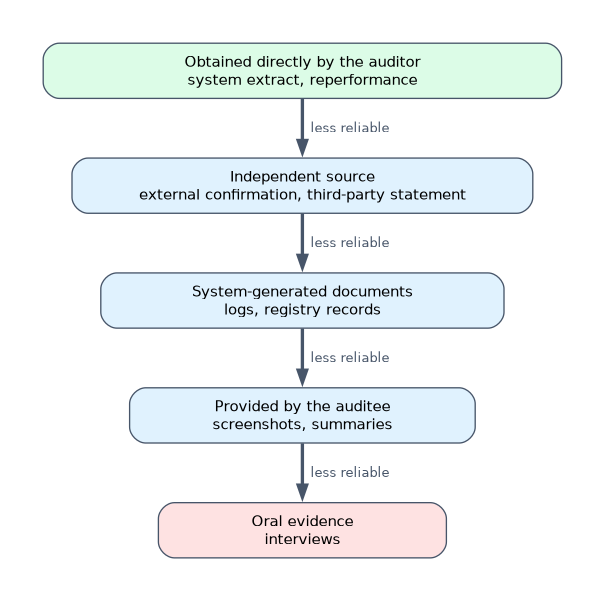
| More reliable | Less reliable |
|---|---|
| Obtained directly by the auditor (system extract, reperformance) | Provided by the auditee (screenshot, summary) |
| From an independent source (external confirmation, third-party statement) | From the area being audited |
| Documented and system-generated (logs, registry records) | Oral (interview) |
| Produced by a tested, controlled system | Produced by an uncontrolled spreadsheet or notebook |
| Original or verified | Copy with no integrity check |
A screenshot of a monitoring dashboard sent by the model owner is weaker than a log extract the auditor ran from the monitoring system.
AI evidence artefacts
| Artefact | What it shows |
|---|---|
| AI inventory and model registry | Systems, versions, owners, approval status |
| Model cards and datasheets | Purpose, data, limitations, intended use |
| Impact and risk assessments | Risks considered before deployment |
| Validation and test reports | Performance, fairness and robustness results |
| Change records and pipeline logs | Approvals and tests for each release |
| Configuration baselines | Approved thresholds, prompts and settings |
| Decision and prompt logs | What the system did in production |
| Monitoring dashboards and alerts | KPIs, KRIs and breaches |
| Override and appeal records | Human oversight in action |
| Incident and problem records | Response and root cause |
| Vendor contracts and assurance reports | Third-party obligations and controls |
Reproducibility and point-in-time evidence
When the auditor tests a model directly, the evidence must record the model version, input data, settings such as temperature for generative models, prompts used, date and the output. Without these, nobody can repeat the test or confirm the result.
Models change. Evidence that a control worked last week may not describe the current model. The auditor notes the period and version each piece of evidence covers.
Generative AI evidence
When testing a generative system, the auditor uses a fixed set of prompts, runs each more than once where variation matters, and keeps the full prompt and response. Single impressive or alarming answers are anecdotes, not evidence of a rate.
Integrity of extracted data
The auditor checks the extraction itself: the query used, record counts reconciled to the source, and hash values or other integrity checks for large files. Where possible, the auditor runs or observes the extraction rather than accepting a file prepared by the auditee.
Interviews and observation
Interviews explain process and intent but must be corroborated. Observation shows how reviewers really handle AI output, which documents alone cannot. Both are useful to understand automation bias.
Evidence from third parties
For vendor AI, evidence may come from the vendor's assurance reports, certificates or answers to questionnaires. The auditor checks scope, period, the independence of whoever produced it, and any exceptions or complementary controls the customer must operate.
Work papers and confidentiality
Work papers record what was tested, how, the evidence and the conclusion, so another auditor could reach the same view. AI evidence often includes personal data in logs and prompts, so it must be stored securely, accessed only as needed and retained per audit policy.
A worked example
A model owner sends the auditor a screenshot showing all fairness checks passed this quarter. The auditor instead requests read access to the monitoring tool, runs the report for the full quarter and finds two weeks with no data, during which a pipeline was down.
The auditor reports a gap in monitoring coverage and notes that the auditor-obtained extract, not the screenshot, supports the conclusion.
How the exam asks about this
- "Which evidence is MOST reliable that a model was approved before deployment?" System-generated registry or pipeline records showing approval before the deployment timestamp.
- "What should the auditor record when testing a generative AI system directly?" The model version, settings, exact prompts, date and full outputs, so the test can be reproduced.
- "An interview says monitoring alerts are reviewed daily. What should the auditor do NEXT?" Corroborate by inspecting alert logs and evidence of review.
What to remember for the exam
- Evidence must be sufficient, relevant and reliable.
- Auditor-obtained and system-generated beats auditee-provided and oral.
- Record model version, settings and inputs for reproducibility.
- Generative tests need fixed prompts and repeated runs.
- Corroborate interviews; protect personal data in evidence.
Evidence about one model version says nothing reliable about another. Always tie AI evidence to the version and period it covers.
Common mistakes
Relying on screenshots from the auditee. Obtain extracts directly where possible.
Treating one striking output as proof. Probabilistic systems need repeated, structured tests.
Forgetting complementary controls in vendor reports. The customer may need to operate controls the report assumes.
Check yourself
What makes audit evidence appropriate?
It is relevant to the objective tested and reliable, considering its source, independence and how it was obtained.
Why must AI evidence record the model version?
Models change, so evidence is only meaningful for the version and period it actually covers.
Why should the auditor run data extractions directly where possible?
To make sure the data is complete and unaltered, rather than relying on a file the auditee prepared.
Topic 3 of 5 in AI Auditing Tools and Techniques
Test yourself on AI Auditing Tools and Techniques
The full ISACA AAIA question bank has 750 questions, with timed practice exams and an explanation for every answer.
This study guide is independent and is not affiliated with, endorsed by, or sponsored by ISACA. Vendor names, certification names and exam codes are trademarks of their respective owners and are used for identification only.