Firewall User Management Technologies · Topic 1 of 2
AAA Principles
Learn AAA authentication, authorization and accounting, local, RADIUS and HWTACACS schemes, domains and a basic aaa setup on Huawei firewalls for H12-711.
- 4 min
- Includes a diagram
- AAA is authentication (who), authorization (what may be done) and accounting (what was done).
- Authentication modes include local, RADIUS, HWTACACS and none; the firewall can also use AD and LDAP servers.
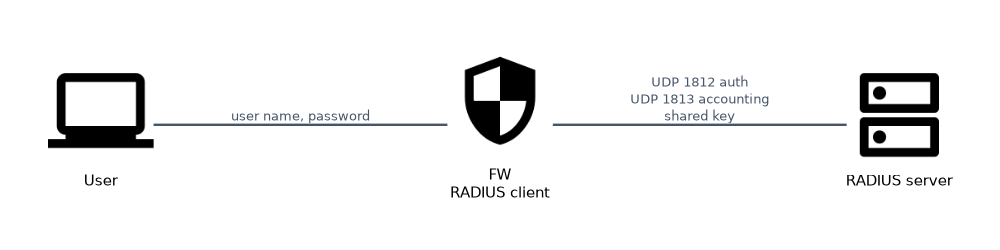
- RADIUS uses UDP 1812 and 1813, encrypts only the password and combines authentication with authorization.
What it is
AAA stands for Authentication, Authorization and Accounting. It is the framework a network device uses to decide who a user is, what the user may do, and what the user did.
The device that users connect to, such as a USG firewall, acts as the AAA client, also called the NAS (network access server). It checks users against its own local database or asks a central AAA server.
How it works
The three functions
| Function | Question it answers | Example |
|---|---|---|
| Authentication | Who are you? | Checking a user name and password |
| Authorization | What may you do? | Granting an administrator level, or which resources a user may reach |
| Accounting | What did you do? | Recording login time, duration and traffic |
Authentication comes first, authorization follows, and accounting runs for the whole session.
Schemes and modes
Each function is configured as a scheme that lists the modes to use.
| Function | Common modes |
|---|---|
| Authentication | Local, RADIUS, HWTACACS, none; a firewall also supports servers such as AD and LDAP |
| Authorization | Local, HWTACACS, if authenticated, none; with RADIUS, authorization comes with authentication |
| Accounting | RADIUS, HWTACACS, none |
Local mode checks users stored on the device itself. It is simple and needs no server, but every device holds its own copy, so it suits small networks and backup logins.
Remote modes use a server, so accounts are managed in one place for many devices. A scheme can list a remote mode and then local, so local accounts still work if the server is unreachable.
RADIUS and HWTACACS
| Item | RADIUS | HWTACACS |
|---|---|---|
| Transport | UDP | TCP |
| Ports | 1812 authentication, 1813 accounting | 49 |
| Encryption | Only the password field | The whole packet body |
| Authentication and authorization | Combined in one exchange | Separate, so each can use a different server |
| Command authorization | Not supported | Supported, each command can be checked |
| Typical use | Network access users | Device administrators |
RADIUS is an open standard. HWTACACS is Huawei's enhanced protocol based on TACACS, and it is similar in principle to TACACS+.
In RADIUS, the client and server share a key. The client sends an Access-Request, and the server answers with Access-Accept, Access-Reject or Access-Challenge.
Domains
A domain groups users and the schemes that apply to them. A user name such as user1@sales puts the user in the domain sales.
A user who enters no domain belongs to the default domain. Different domains can use different servers, so one firewall can serve several departments or customers.
A basic aaa configuration
aaa
 authentication-scheme admin_auth
  authentication-mode radius local
This scheme tries the RADIUS server first and falls back to the local user database only if the server does not respond. A user that RADIUS rejects is not retried locally.
A worked example
A company has twenty firewalls and routers. Each engineer must log in with a personal account, every command must be checked against the engineer's role, and the commands must be recorded.
The engineer picks HWTACACS, because it separates authorization from authentication and supports command authorization and accounting. A local administrator account stays on each device, with local as the fallback mode for when the server is down.
How the exam asks about this
- "Which AAA function records the time a user stayed online?" -> Accounting.
- "Which protocol uses TCP port 49 and encrypts the entire packet body?" -> HWTACACS.
- "Which RADIUS port is used for accounting by default?" -> UDP 1813.
What to remember for the exam
- AAA is authentication (who), authorization (what may be done) and accounting (what was done).
- Authentication modes include local, RADIUS, HWTACACS and none; the firewall can also use AD and LDAP servers.
- RADIUS uses UDP 1812 and 1813, encrypts only the password and combines authentication with authorization.
- HWTACACS uses TCP 49, encrypts the whole body, separates the three functions and supports command authorization.
- Users without a domain in the name belong to the default domain.
A fallback to local is used only when the remote server does not answer. If the server answers with a reject, the user is rejected and local accounts are not checked.
Common mistakes
Mixing up authentication and authorization. Checking the password is authentication; deciding the level or resources after login is authorization.
Giving RADIUS command authorization. RADIUS has no per-command authorization; that is a reason to choose HWTACACS for administrators.
Saying RADIUS encrypts the whole packet. Only the password field is hidden with the shared key; the rest of the RADIUS packet travels in clear text.
Check yourself
Why would a scheme list
radius localinstead of onlyradius?So that local accounts still work when the RADIUS server is unreachable, while normal logins use the central server.
Which protocol separates authentication, authorization and accounting?
HWTACACS, which runs over TCP port 49 and can authorize each command.
Which domain does a user who logs in as
alicebelong to?The default domain, because the user name contains no domain part.
Topic 1 of 2 in Firewall User Management Technologies
Test yourself on Firewall User Management Technologies
The full Huawei HCIA-Security H12-711 question bank has 600 questions, with timed practice exams and an explanation for every answer.
This study guide is independent and is not affiliated with, endorsed by, or sponsored by Huawei. Vendor names, certification names and exam codes are trademarks of their respective owners and are used for identification only.