Firewall NAT Technologies · Topic 3 of 3
NAT ALG and NAT Server
Learn NAT ALG, ASPF and server map entries for FTP and other multi-channel protocols, and how to publish servers with nat server on USG firewalls.
- 6 min
- Includes a diagram
- Multi-channel protocols such as FTP, SIP, H.323 and RTSP carry addresses and ports in the payload.
- ASPF learns the data channel and creates a temporary server map entry; NAT ALG rewrites addresses in the payload.
- Both are enabled with
detect, for examplefirewall detect ftpordetect ftpin an interzone view.
What it is
NAT ALG (Application Level Gateway) translates IP addresses and ports that a protocol carries inside the payload, not just in the IP header. Without it, protocols such as FTP break as soon as NAT is applied.
NAT Server publishes an inside server on a public address and port. It is the main form of destination NAT on a USG firewall and creates server map entries that the firewall uses to translate incoming traffic.
How it works
Multi-channel protocols
A single-channel protocol, such as HTTP, uses one connection. A multi-channel protocol opens a control channel and then negotiates a second, data channel whose address and port are written in the control messages.
| Protocol | How the data channel is negotiated |
|---|---|
| FTP active mode | The client sends a PORT command with its address and port; the server connects back from port 20 |
| FTP passive mode | The server answers PASV with its address and port; the client connects to it |
| SIP, H.323, RTSP | Signaling messages carry the media addresses and ports |
Two problems follow. The security policy has no rule for the dynamic data channel, and after NAT the address in the payload is the private one, which the outside peer cannot reach.
ASPF and NAT ALG
ASPF (Application Specific Packet Filter) inspects the application layer of the control channel. It learns the negotiated data channel and creates a temporary server map entry, so the data connection is allowed without opening a wide rule.
NAT ALG works with ASPF. When NAT is applied, it replaces the private address and port in the payload with the translated public ones, so the peer connects to an address that works.
Both are enabled per protocol with the detect command, globally or between two zones:
firewall detect ftp
#
firewall interzone trust untrust
 detect ftp
The server map
The server map is a table of mappings, separate from the session table. When a first packet matches no session, the firewall checks the server map, translates if needed, and creates a session.
| Server map type | Created by | Purpose |
|---|---|---|
| ASPF | ASPF learning a data channel | Lets the negotiated data connection through; ages out quickly |
| NAT Server and its reverse entry | nat server configuration | Static translation of the published address; stays while configured |
| No-PAT | NAT No-PAT translations | Fixed private to public mapping in both directions |
| FullCone | Triplet NAT translations | Lets outside hosts reach the mapped address and port |
A server map entry is not a session. Use display firewall server-map for the mappings and display firewall session table for live connections.
Configuring NAT Server
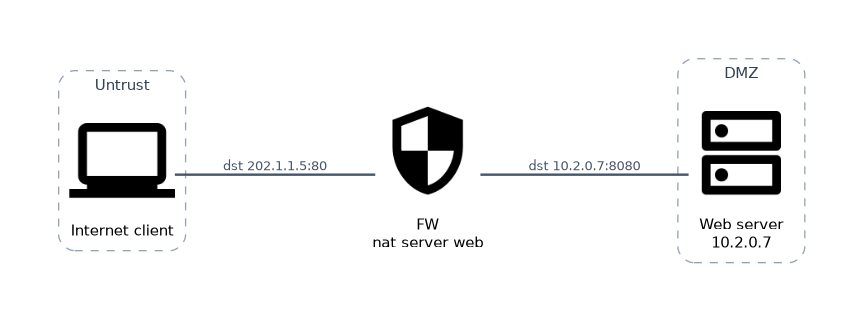
nat server web protocol tcp global 202.1.1.5 www inside 10.2.0.7 8080
nat server mail global 202.1.1.6 inside 10.2.0.8
The first line maps TCP port 80 (www) on 202.1.1.5 to port 8080 on 10.2.0.7, a port based mapping. The second maps every port of 202.1.1.6 to 10.2.0.8, an address based mapping that publishes the whole server.
NAT Server creates two static server map entries. The forward entry translates incoming traffic from the public to the private address. The reverse entry lets the server start connections to the internet with the public address as its source. The no-reverse keyword creates only the forward entry.
A security policy from Untrust to DMZ must still permit the traffic, using the private server address, and the public address should have a blackhole route to prevent loops.
A worked example
Users in the Trust zone use Easy IP to reach an FTP server on the internet in active mode. The data connection fails: the client logs in, but directory listings never arrive.
The PORT command still carries the private client address, and no rule permits the server's data connection. After firewall detect ftp, NAT ALG rewrites the PORT command with the public address, ASPF creates a server map entry for the data channel, and the listing works.
How the exam asks about this
- "Which feature translates addresses carried in the FTP payload?" -> NAT ALG.
- "Which table holds the entry that lets the negotiated FTP data channel through?" -> The server map, with an ASPF entry.
- "What does the reverse server map entry created by NAT Server allow?" -> The inside server can start outbound connections using its public address.
What to remember for the exam
- Multi-channel protocols such as FTP, SIP, H.323 and RTSP carry addresses and ports in the payload.
- ASPF learns the data channel and creates a temporary server map entry; NAT ALG rewrites addresses in the payload.
- Both are enabled with
detect, for examplefirewall detect ftpordetect ftpin an interzone view. nat servercreates static forward and reverse server map entries;no-reversekeeps only the forward one.- The security policy for a published server uses the private server address, and the public address needs a blackhole route.
Configuring NAT Server does not permit any traffic. Without a security policy from Untrust to the server's zone, the default deny policy still drops every request.
Common mistakes
Confusing the server map with the session table. The server map holds mappings that let a first packet be translated or admitted; the session table holds the live connections that result.
Blaming the NAT policy when FTP lists fail. Login works because the control channel is fine. The data channel fails until ASPF and NAT ALG handle the payload.
Expecting no-reverse to keep outbound access. Without the reverse entry, the server's own outbound connections are not translated by the NAT Server mapping.
Check yourself
Why does FTP need NAT ALG when NAT is used?
FTP sends the data channel address and port inside the control messages, so they must be translated in the payload too.
What two server map entries does
nat servercreate?A forward entry for incoming traffic to the public address and a reverse entry for connections the server starts outward.
Which command shows the server map entries?
display firewall server-map, which lists ASPF, NAT Server and other mapping entries.
Topic 3 of 3 in Firewall NAT Technologies
Test yourself on Firewall NAT Technologies
The full Huawei HCIA-Security H12-711 question bank has 600 questions, with timed practice exams and an explanation for every answer.
This study guide is independent and is not affiliated with, endorsed by, or sponsored by Huawei. Vendor names, certification names and exam codes are trademarks of their respective owners and are used for identification only.