Managing and provisioning a solution infrastructure · Topic 5 of 6
ML Workflows on Agent Platform and AI Hypercomputer
Automating the ML lifecycle with Agent Platform Pipelines, preparing data, training on GPUs and TPUs with AI Hypercomputer, and choosing consumption models.
- 4 min
- Includes a diagram
- Pipelines automate and trace the ML lifecycle; condition steps gate deployment.
- Model Registry for versions, model monitoring for drift, Gen AI evaluation for generative quality.
- BigQuery ML for SQL teams; Feature Store for consistent features.
What it is
Gemini Enterprise Agent Platform (formerly Vertex AI) is Google Cloud's managed platform for building, training, deploying and monitoring models and agents. An architect does not tune models, but must design the workflow around them: data in, repeatable training, controlled deployment, monitoring, and the right hardware at the right price.
How it works
Agent Platform Pipelines
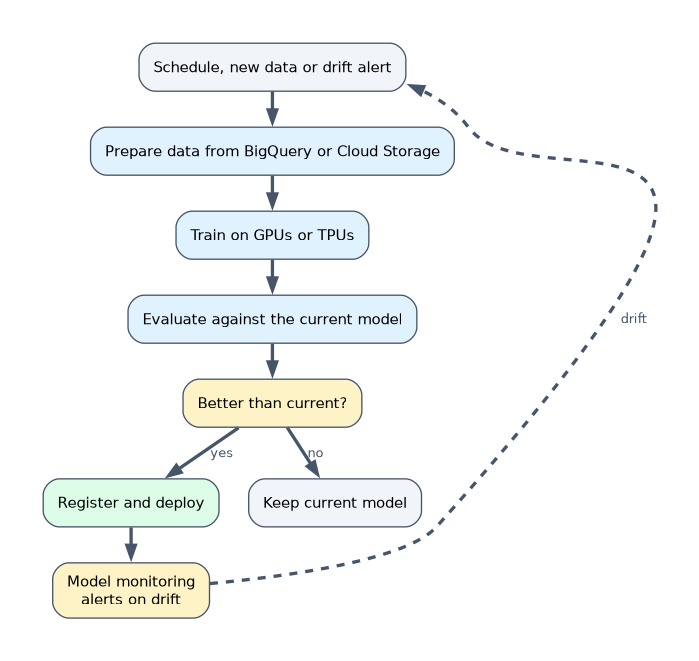 Pipelines automate the ML lifecycle as steps: prepare data, train, evaluate, and register or deploy. They record metadata and lineage, so every model can be traced back to its data and code. A condition step can register or deploy a model only when its evaluation beats the current one. Pipelines can run on a schedule or be triggered by events such as new data landing.
| Need | Agent Platform feature |
|---|---|
| Repeatable, traceable training | Pipelines with metadata and lineage |
| Track model versions | Model Registry |
| Try many hyperparameter combinations in parallel | Hyperparameter tuning jobs |
| Detect when live data drifts from training data | Model monitoring with alert thresholds |
| Compare generative model versions against reference answers | Gen AI evaluation |
| Predictions for large sets at low cost | Batch inference |
| Low-latency predictions | Online endpoints |
Preparing data for Agent Platform
- Keep training data in BigQuery or Cloud Storage, in the same region as training to meet residency rules.
- Use Dataflow or SQL to clean and transform; use Feature Store to share and serve features consistently in training and serving.
- Label data where supervised training needs it; record data versions so pipelines can reproduce results.
- For SQL-only teams, BigQuery ML trains and predicts with SQL inside BigQuery, often enough for forecasting and classification.
AI Hypercomputer
AI Hypercomputer is Google Cloud's integrated system for AI workloads: GPU and TPU hardware, high-performance storage and networking, software frameworks and flexible consumption models. It runs on Compute Engine, GKE and Agent Platform.
| Accelerator | Typical fit |
|---|---|
| GPUs | Broad framework support, training and inference, graphics and simulation |
| TPUs | Large-scale training and serving of models built for them (JAX, TensorFlow, PyTorch/XLA) |
Consumption models
| Model | Fits |
|---|---|
| On demand | Short or unpredictable needs |
| Committed use discounts and reservations | Steady, long-running capacity |
| Spot | Fault-tolerant training with checkpoints |
| Dynamic Workload Scheduler (flex-start and calendar modes) | Getting scarce accelerators for a job that can wait to start, or reserving them for a fixed window |
For large training runs, checkpoint often. Checkpoints let jobs survive Spot interruptions and hardware failures without starting over.
Serving choices
| Pattern | Use |
|---|---|
| Batch inference | Large back catalogs, nightly scoring, lowest cost |
| Online endpoint | Interactive apps needing answers per request |
| Cloud Run with GPUs or GKE | Serving open models in your own containers |
How the exam asks about this
- "Train monthly, traceable from data to model, deploy only if it beats the current model." Agent Platform Pipelines with a condition step.
- "40 hyperparameter combinations on GPUs in parallel, data stays in the EU." Hyperparameter tuning job in an EU region.
- "Retrain only when live data drifts." Model monitoring on the endpoint.
What to remember for the exam
- Pipelines automate and trace the ML lifecycle; condition steps gate deployment.
- Model Registry for versions, model monitoring for drift, Gen AI evaluation for generative quality.
- BigQuery ML for SQL teams; Feature Store for consistent features.
- AI Hypercomputer combines GPUs, TPUs, storage, networking and consumption models.
- Batch inference for cost, online endpoints for latency.
Scheduled retraining without an evaluation gate can replace a good model with a worse one.
Common mistakes
Manual notebooks for production training. No lineage, no repeatability.
Online endpoints for nightly scoring. Batch prediction is cheaper.
Ignoring region when training data must stay in a geography.
Check yourself
Which Agent Platform feature records lineage from data to deployed model?
Agent Platform Pipelines, through their metadata.
How do you retrain only when production inputs move away from the training data?
Turn on model monitoring with the training data as baseline and alert thresholds.
What lets SQL analysts train and score models without leaving BigQuery?
BigQuery ML.
Topic 5 of 6 in Managing and provisioning a solution infrastructure
Test yourself on Managing and provisioning a solution infrastructure
The full Google Cloud Professional Cloud Architect question bank has 877 questions, with timed practice exams and an explanation for every answer.
This study guide is independent and is not affiliated with, endorsed by, or sponsored by Google Cloud. Vendor names, certification names and exam codes are trademarks of their respective owners and are used for identification only.