Techniques to improve gen AI model output · Topic 3 of 5
Prompt Engineering Techniques
Prompt engineering for LLMs: zero-shot, one-shot, few-shot, role prompting, prompt chaining, chain-of-thought and ReAct prompting, with when to use each.
- 4 min
- Includes a diagram
- Prompt engineering is the cheapest, fastest way to improve output.
- Zero-shot: no examples. One-shot: one. Few-shot: several.
- Role prompting sets perspective; prompt chaining splits tasks into steps.
What it is
Prompt engineering is the practice of designing the input to a large language model so that it produces the most useful output. It matters because the same model can give a vague answer or an excellent one depending on the prompt, and prompting is the cheapest and fastest way to improve results: no training, no new data pipeline.
How it works
What a good prompt contains
| Element | Example |
|---|---|
| Task | "Summarize this complaint." |
| Context | "The reader is a store manager with two minutes." |
| Constraints | "Three bullet points, no more than 60 words." |
| Examples | One or more sample inputs with the desired outputs |
| Format | "Return JSON with fields issue, urgency, next_step." |
The basic techniques
| Technique | How it works | When to use it |
|---|---|---|
| Zero-shot | Give the instruction with no examples | Simple, common tasks the model already understands |
| One-shot | Give one example of input and desired output | Show a specific format or style once |
| Few-shot | Give several examples | When consistency matters, or the task or labels are specific to your business |
| Role prompting | Ask the model to act as a role: "You are an experienced compliance officer" | Set tone, perspective and level of expertise |
| Prompt chaining | Split a complex task into steps, feeding each output into the next prompt | Long or multi-stage work, such as extract, then analyze, then draft |
If the model's answers are right but inconsistently formatted, add examples (one-shot or few-shot). If the task is too big for one prompt, chain prompts.
The advanced techniques
| Technique | How it works | When to use it |
|---|---|---|
| Chain-of-thought (CoT) prompting | Ask the model to reason step by step before giving the answer, or show examples that include the reasoning | Problems needing several logical steps: calculations, multi-condition decisions |
| ReAct prompting | Short for Reason and Act: the model alternates between reasoning about what to do, acting (calling a tool, such as a search or an API), and observing the result, until it reaches an answer | Tasks that need fresh information or actions in other systems, typical of agents |
Example of few-shot prompting
Classify each support message as Billing, Technical or Account.
Message: "I was charged twice this month." -> Billing
Message: "The app crashes when I upload a photo." -> Technical
Message: "How do I change my email address?" -> Account
Message: "My invoice shows the wrong plan." ->
The examples teach the labels and the format, so the model answers "Billing" consistently.
Example of the ReAct pattern
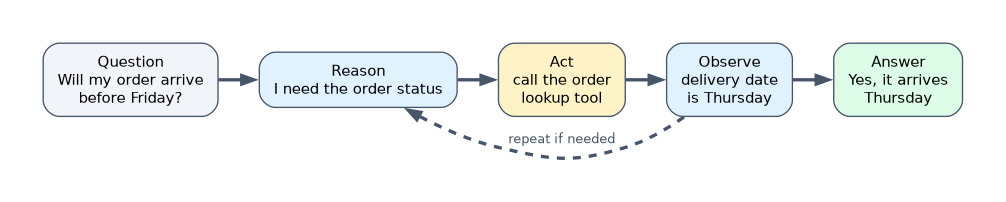 A customer asks, "Will my order arrive before Friday?" The model reasons that it needs the order status, acts by calling an order lookup tool, observes the expected delivery date, then reasons about the answer and replies. This is how many agents work.
Limits of prompting
Prompting cannot give a model facts it does not have (that needs grounding) and cannot reliably change deeply ingrained behavior at very high volume (that may need tuning). It is the first step, not the only one.
A worked scenario
An insurer's team writes claim summaries. A zero-shot prompt gives uneven results, so they add few-shot examples of good summaries. For complex claims they use prompt chaining: extract facts, then check policy terms, then draft. To decide coverage they ask for chain-of-thought reasoning, and their claims agent uses ReAct to look up policy data before answering. A role prompt sets the tone: "You are a careful claims adjuster."
How the exam asks about this
- "Provide several examples to get consistent output." Few-shot.
- "Ask the model to explain its reasoning step by step." Chain-of-thought.
- "The model reasons, calls a tool, observes the result, and continues." ReAct.
- "Break a complex task into a sequence of prompts." Prompt chaining.
- "Tell the model to answer as a financial advisor." Role prompting.
What to remember for the exam
- Prompt engineering is the cheapest, fastest way to improve output.
- Zero-shot: no examples. One-shot: one. Few-shot: several.
- Role prompting sets perspective; prompt chaining splits tasks into steps.
- Chain-of-thought: step-by-step reasoning. ReAct: reasoning plus tool actions.
- Prompting cannot add missing facts; grounding does.
Few-shot examples teach patterns, including mistakes. Use correct, representative examples.
Common mistakes
Confusing chain-of-thought with prompt chaining. CoT reasons within one answer; chaining links several prompts.
Expecting zero-shot to match a company-specific format. Show examples.
Using ReAct without tools. Its point is acting through tools and observing results.
Check yourself
What is few-shot prompting?
Including several examples of input and desired output in the prompt so the model follows the pattern.
What does ReAct stand for and do?
Reason and Act: the model alternates reasoning with tool actions and observations until it reaches an answer.
How does prompt chaining differ from chain-of-thought?
Prompt chaining splits a task across several prompts; chain-of-thought asks for step-by-step reasoning within one response.
Topic 3 of 5 in Techniques to improve gen AI model output
Test yourself on Techniques to improve gen AI model output
The full Google Cloud Generative AI Leader question bank has 512 questions, with timed practice exams and an explanation for every answer.
This study guide is independent and is not affiliated with, endorsed by, or sponsored by Google Cloud. Vendor names, certification names and exam codes are trademarks of their respective owners and are used for identification only.