Techniques to improve gen AI model output · Topic 1 of 5
Foundation Model Limitations and How to Address Them
Foundation model limits such as hallucinations, knowledge cutoff and bias, and the fixes: grounding, RAG, prompt engineering, fine-tuning and human review.
- 4 min
- Includes a diagram
- Limitations: data dependency, knowledge cutoff, bias, fairness, hallucinations, edge cases.
- Practices: grounding, RAG, prompt engineering, fine-tuning, human in the loop.
- Grounding and RAG fix missing or outdated knowledge and reduce hallucinations.
What it is
Foundation models have predictable weaknesses. The exam lists them: data dependency, the knowledge cutoff, bias, fairness, hallucinations and edge cases. It also lists the practices Google Cloud recommends: grounding, retrieval-augmented generation (RAG), prompt engineering, fine-tuning and human in the loop (HITL).
How it works
The limitations
| Limitation | What it means | Example |
|---|---|---|
| Data dependency | A model only knows what its training data contained, and inherits its gaps and errors | A model trained mostly on English text performs worse in other languages |
| Knowledge cutoff | The model knows nothing about events after its training data was collected | It does not know about a product launched last month |
| Bias | The model reflects biases in its training data | Generated job descriptions that favor one group |
| Fairness | Outputs may treat people or groups unequally | Different quality of answers for different dialects |
| Hallucinations | The model produces confident but false or invented information | It cites a policy clause that does not exist |
| Edge cases | Unusual inputs the model rarely saw, where it fails unpredictably | A rare product configuration or an unusual document layout |
A hallucination is not the model "lying". It generates plausible text based on patterns, without checking facts. That is why grounding in trusted sources helps so much.
The recommended practices
| Practice | What it does | Best against |
|---|---|---|
| Grounding | Connects the model's answers to verifiable sources of information | Hallucinations, knowledge cutoff |
| Retrieval-augmented generation (RAG) | A grounding method: retrieve relevant trusted content and add it to the prompt before generating | Hallucinations, knowledge cutoff, private knowledge |
| Prompt engineering | Clear instructions, examples and context in the prompt | Format, tone, task clarity, some reasoning errors |
| Fine-tuning | Further trains the model on curated examples, adjusting its weights | Specialized style, vocabulary or task behavior that prompting cannot reach |
| Human in the loop (HITL) | People review, approve or correct outputs at key points | High-stakes decisions, edge cases, bias and fairness risks |
Choosing a practice
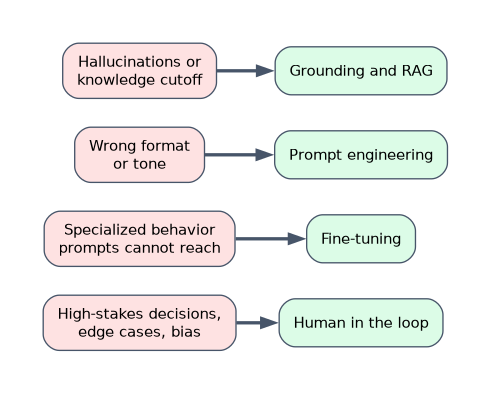
| Problem | First choice |
|---|---|
| Answers about recent or internal information are wrong | Grounding with RAG |
| Output format is inconsistent | Prompt engineering (instructions and examples) |
| The model must adopt a specialized style across thousands of requests and prompting is not enough | Fine-tuning |
| Decisions affect people's money, health or rights | Human in the loop |
| Bias in outputs | Better data, evaluation, and human review |
Start with the cheapest, fastest technique (prompting), add grounding for facts, consider fine-tuning when behavior must change, and keep humans where risk is high.
Why fine-tuning is not a fix for fresh facts
Fine-tuning teaches style and behavior well, but it is a poor way to keep facts current: every change would need another training run. Facts that change often belong in a grounding source.
A worked scenario
A bank's assistant tells a customer about an interest rate that changed last week (knowledge cutoff) and invents a fee name (hallucination). The bank grounds answers in its current rate tables with RAG, uses prompt engineering to require answers to cite the source document, and routes any answer about disputes or complaints to a human agent (human in the loop).
How the exam asks about this
- A symptom is described and you name the limitation (invented facts are hallucinations; no knowledge of recent events is the knowledge cutoff).
- A limitation is given and you choose the practice that best addresses it.
- "Which practice ensures a person checks high-impact decisions?" Human in the loop.
What to remember for the exam
- Limitations: data dependency, knowledge cutoff, bias, fairness, hallucinations, edge cases.
- Practices: grounding, RAG, prompt engineering, fine-tuning, human in the loop.
- Grounding and RAG fix missing or outdated knowledge and reduce hallucinations.
- Fine-tuning changes behavior and style; it is not the way to keep facts current.
- HITL protects high-stakes decisions.
No technique removes hallucinations completely. Grounding reduces them; human review catches what remains where it matters.
Common mistakes
Fine-tuning to add last week's prices. Use grounding; facts change too often to retrain.
Treating bias as a prompt problem only. Bias usually starts in data and needs evaluation and oversight.
Removing humans from high-risk processes. The exam favors human in the loop for decisions with major impact.
Check yourself
A model confidently cites a policy that does not exist. Which limitation is this?
A hallucination.
Which practice best addresses a model's knowledge cutoff?
Grounding, for example with retrieval-augmented generation.
When is human in the loop most important?
For high-stakes decisions and edge cases where an error would cause significant harm.
Topic 1 of 5 in Techniques to improve gen AI model output
Test yourself on Techniques to improve gen AI model output
The full Google Cloud Generative AI Leader question bank has 512 questions, with timed practice exams and an explanation for every answer.
This study guide is independent and is not affiliated with, endorsed by, or sponsored by Google Cloud. Vendor names, certification names and exam codes are trademarks of their respective owners and are used for identification only.