Google Cloud's gen AI offerings · Topic 5 of 6
Building with Agent Platform and RAG
How developers build with Gemini Enterprise Agent Platform: Model Garden, Agent Search, AutoML, prebuilt RAG and RAG APIs, and building custom agents.
- 4 min
- Includes a diagram
- Agent Platform (previously Vertex AI) is Google Cloud's unified platform to build with AI.
- Model Garden: model catalog. AutoML: custom models with little code. Agent Search: search and prebuilt RAG.
- RAG retrieves trusted information and adds it to the prompt; it reduces hallucinations without retraining.
What it is
When prebuilt products are not enough, developers build their own gen AI solutions on Gemini Enterprise Agent Platform (previously Vertex AI), Google Cloud's unified AI development platform. The exam highlights Model Garden, Agent Search, AutoML, Google Cloud's RAG offerings (prebuilt RAG with Agent Search, and RAG APIs) and building custom agents.
How it works
Agent Platform components
| Component | What it does | Business value |
|---|---|---|
| Model Garden | A catalog to discover, test, customize and deploy Google, partner and open models | Choice of the right model for each task in one place |
| Agent Search | Search and generative answers over the organization's data; prebuilt RAG | Grounded answers without building retrieval from scratch |
| Agent Platform AutoML | Trains custom models on your data with little or no ML code | Custom models without an ML team |
| Agent building and runtime | Tools and a managed runtime to build, deploy and scale agents | Move from prototype to production with security and governance |
| Tuning, evaluation and monitoring | Adapt models, compare outputs and watch quality in production | Better and safer results over time |
Retrieval-augmented generation (RAG)
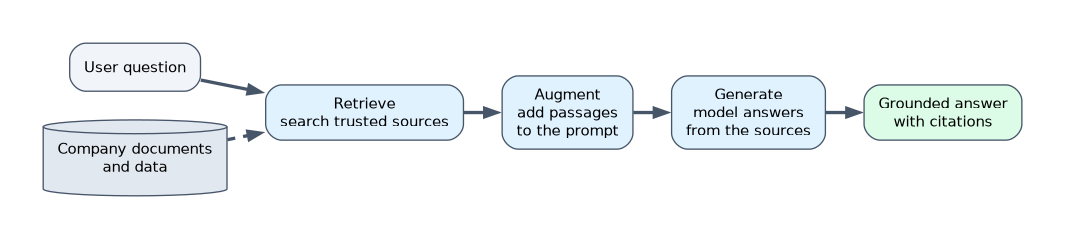 RAG improves a model's answers by first retrieving relevant information from trusted sources, then adding it to the prompt so the model generates an answer based on that information. It reduces hallucinations, uses current data, and lets answers cite sources, without retraining the model.
Google Cloud offers two ways to do RAG:
| Option | What it is | Best for |
|---|---|---|
| Prebuilt RAG with Agent Search | An out-of-the-box engine that ingests data, indexes it, retrieves and generates grounded answers | Fast results with little engineering |
| RAG APIs | Building-block APIs for teams that assemble their own RAG pipeline, such as parsing documents, creating embeddings, ranking results and checking grounding | Teams needing more control over each step |
"Fastest way to give a gen AI app answers from our documents" is prebuilt RAG with Agent Search. "We need control over each step of retrieval" is the RAG APIs.
Building custom agents
A custom agent combines a model with instructions, tools (APIs, functions, data stores) and orchestration that decides which step comes next. On Agent Platform, developers can build agents, connect them to enterprise data and systems, test them, deploy them to a managed runtime, and monitor them.
Business value of custom agents:
- Automate multi-step processes unique to the business, such as claims handling or order exceptions.
- Use proprietary data and systems that prebuilt agents cannot reach.
- Keep governance: identity, permissions and logging are controlled by the organization.
Buy or build
| Situation | Choice |
|---|---|
| Common productivity needs | Prebuilt (Gemini Enterprise, Workspace) |
| Customer search over own content, quickly | Agent Search |
| A unique process needing actions in internal systems | Custom agent on Agent Platform |
| A custom prediction model without ML experts | AutoML |
A worked scenario
An insurer wants a claims assistant. Developers pick Gemini in Model Garden, use prebuilt RAG with Agent Search over policy documents so answers cite the right clause, and build a custom agent on Agent Platform with tools to read claim records and create payment requests. A separate damage-photo classifier is trained with AutoML. The agent is deployed to the managed runtime and monitored.
How the exam asks about this
- "Browse and deploy models from Google and partners." Model Garden.
- "Ground answers in company documents with minimal engineering." Prebuilt RAG with Agent Search.
- "Build each step of the retrieval pipeline ourselves." RAG APIs.
- "Automate a unique multi-step process using internal systems." A custom agent on Agent Platform.
What to remember for the exam
- Agent Platform (previously Vertex AI) is Google Cloud's unified platform to build with AI.
- Model Garden: model catalog. AutoML: custom models with little code. Agent Search: search and prebuilt RAG.
- RAG retrieves trusted information and adds it to the prompt; it reduces hallucinations without retraining.
- RAG options: prebuilt with Agent Search, or RAG APIs for control.
- Custom agents: model plus instructions, tools and orchestration, governed by the organization.
RAG does not change the model's weights. It changes what information the model sees at the time of the request.
Common mistakes
Choosing fine-tuning to add frequently changing facts. RAG keeps answers current without retraining.
Building custom when prebuilt fits. Start with prebuilt offerings for common needs.
Confusing Model Garden with Agent Search. One is a model catalog; the other searches your data.
Check yourself
What does retrieval-augmented generation do?
It retrieves relevant trusted information and adds it to the prompt so the model's answer is grounded in it.
Which Agent Platform component is a catalog of Google, partner and open models?
Model Garden.
When would a team choose the RAG APIs over prebuilt RAG with Agent Search?
When it needs control over each step of the retrieval pipeline.
Topic 5 of 6 in Google Cloud's gen AI offerings
Test yourself on Google Cloud's gen AI offerings
The full Google Cloud Generative AI Leader question bank has 512 questions, with timed practice exams and an explanation for every answer.
This study guide is independent and is not affiliated with, endorsed by, or sponsored by Google Cloud. Vendor names, certification names and exam codes are trademarks of their respective owners and are used for identification only.