Modernizing Infrastructure and Applications with Google Cloud · Topic 3 of 5
Modern Applications with GKE and Serverless
The business value of modern application development, GKE for containers, and serverless with Cloud Run and Cloud Run functions, for the Cloud Digital Leader.
- 4 min
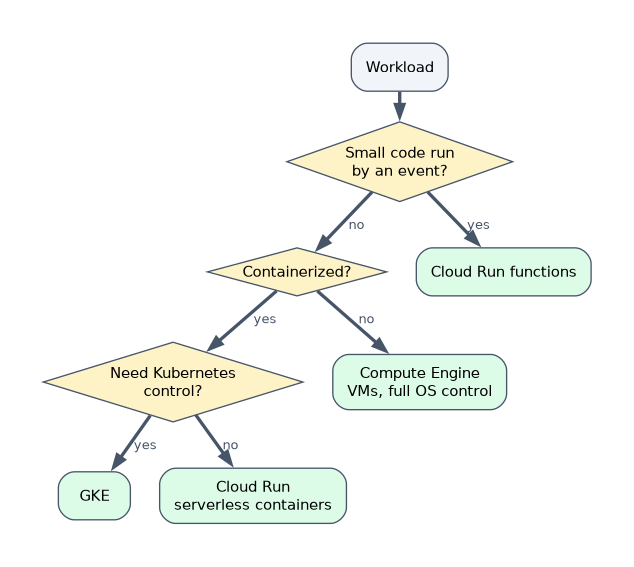
- Includes a diagram
- Modern app development: microservices, automated deployment, managed services, cost optimization, scalability, resilience, efficiency.
- GKE: managed Kubernetes; Autopilot also manages nodes.
- Cloud Run: serverless containers, scales to zero.
What it is
Modern application development builds applications from flexible pieces (often microservices in containers), deploys them through automated processes and relies on managed services. Google Cloud's main products for it are Google Kubernetes Engine (GKE) for running containers, and the serverless products Cloud Run and Cloud Run functions.
How it works
Business value of modern application development
| Value | How it is achieved |
|---|---|
| Flexible architectures | Microservices can be built, changed and scaled independently |
| Accelerated deployment | Automated build and release pipelines and managed services ship changes often |
| Cost optimization | Pay for what runs; scale down when idle; less infrastructure to manage |
| Enhanced scalability and resilience | Each service scales on its own; one failing service does not stop the rest |
| Improved operational efficiency | Managed platforms handle patching, scaling and much of the monitoring |
When a scenario says "release features faster" or "teams blocked by one large codebase", think microservices plus managed services.
Google Kubernetes Engine (GKE)
GKE is Google's managed Kubernetes service for deploying and managing containers.
| Business value | Explanation |
|---|---|
| Managed Kubernetes | Google runs the control plane and handles upgrades and much of the operations |
| Autopilot mode | Google also manages the nodes; you pay for the resources your workloads request |
| Portability | Kubernetes is open source, so containers run the same on other clouds and on premises |
| Scale | Autoscaling of pods and nodes to match demand |
| Reliability | Regional clusters spread across zones; self-healing restarts failed containers |
GKE fits organizations that run many containerized services and want Kubernetes control, consistency across environments or advanced configuration.
Serverless: Cloud Run and Cloud Run functions
| Product | What you deploy | Typical use | Scaling |
|---|---|---|---|
| Cloud Run | A container | Web apps, APIs, microservices, background jobs | Scales automatically with requests, down to zero when idle |
| Cloud Run functions | A single function (a small piece of code) | Respond to events: a file uploaded, a message published, an HTTP call | Runs only when triggered |
Business value of serverless:
- No infrastructure management: no servers, clusters or operating systems.
- Pay per use: no charge when nothing runs, which suits variable or low traffic.
- Fast to market: developers only write and deploy code.
- Automatic scaling from zero to large traffic.
Cloud Run functions were previously named Cloud Functions.
Choosing between them
| Need | Choice |
|---|---|
| Existing app, full OS control | Compute Engine |
| Many containers, Kubernetes control, portability | GKE |
| Containerized app with no infrastructure to manage | Cloud Run |
| Small code that reacts to an event | Cloud Run functions |
A worked scenario
A ticketing startup has unpredictable traffic: quiet most days, then huge spikes when concerts go on sale. It runs its web front end and APIs on Cloud Run, which scales up during sales and to zero overnight. A Cloud Run function resizes uploaded event images. Its larger partner, already running dozens of containerized services with Kubernetes, uses GKE for control and portability across environments.
How the exam asks about this
- "Run containers without managing servers or clusters." Cloud Run.
- "Run code automatically when a file is uploaded." Cloud Run functions.
- "Manage many containerized microservices with Kubernetes." GKE.
- "Business benefit of microservices." Independent changes and scaling, faster releases, resilience.
What to remember for the exam
- Modern app development: microservices, automated deployment, managed services, cost optimization, scalability, resilience, efficiency.
- GKE: managed Kubernetes; Autopilot also manages nodes.
- Cloud Run: serverless containers, scales to zero.
- Cloud Run functions: event-driven code.
- More management by Google means less control and less operational work.
Serverless is ideal for variable traffic but you give up control of the underlying servers. A workload that needs special OS settings belongs on Compute Engine or GKE.
Common mistakes
Choosing GKE for a single small web app with no Kubernetes skills. Cloud Run is simpler.
Thinking serverless means no code. You still write and own the code.
Confusing Cloud Run with Cloud Run functions. Cloud Run runs containers; functions run small event-triggered code.
Check yourself
Which product runs containers serverlessly and scales to zero?
Cloud Run.
What does GKE Autopilot add?
Google manages the nodes as well as the control plane.
Which product runs a small piece of code when an event such as a file upload occurs?
Cloud Run functions.
Topic 3 of 5 in Modernizing Infrastructure and Applications with Google Cloud
Test yourself on Modernizing Infrastructure and Applications with Google Cloud
The full Google Cloud Digital Leader question bank has 512 questions, with timed practice exams and an explanation for every answer.
This study guide is independent and is not affiliated with, endorsed by, or sponsored by Google Cloud. Vendor names, certification names and exam codes are trademarks of their respective owners and are used for identification only.