Incident Detection and Triage · Topic 1 of 6
SIEM Importance, Architecture and Types
Learn why a SOC needs a SIEM, how its collection, normalization and correlation components fit, and the pros and cons of each SIEM type for CSA 312-39.
- 5 min
- Includes a diagram
- SIEM = SIM (storage, analysis, reporting) + SEM (real time monitoring, correlation, alerting).
- The data path is collect, parse and normalize, aggregate, enrich, correlate, alert, store.
- Normalization lets one rule work across many vendors' logs.
What it is
Security information and event management (SIEM) is the central platform of a SOC. It collects logs and events from across the organization, normalizes them, correlates them, raises alerts, and stores them for search and reporting.
The name joins two older ideas. Security information management (SIM) is long term storage, analysis and reporting of log data. Security event management (SEM) is real time monitoring, correlation and alerting.
How it works
Why a SOC needs a SIEM
A single attack leaves traces in many places: a firewall log, a Windows logon event, a proxy entry. No analyst can read each source separately in time. A SIEM brings them together on one timeline so the pattern becomes visible.
| Benefit | What it gives the SOC |
|---|---|
| Central visibility | One place to see events from network, host, application and cloud |
| Correlation | Links related events across sources into one alert |
| Real time alerting | Warns analysts while an attack is in progress |
| Faster investigation | Search across all sources and time ranges from one console |
| Compliance | Retained logs and ready reports for audits such as PCI DSS or HIPAA |
| Forensic support | Historical data to rebuild what happened |
SIEM architecture
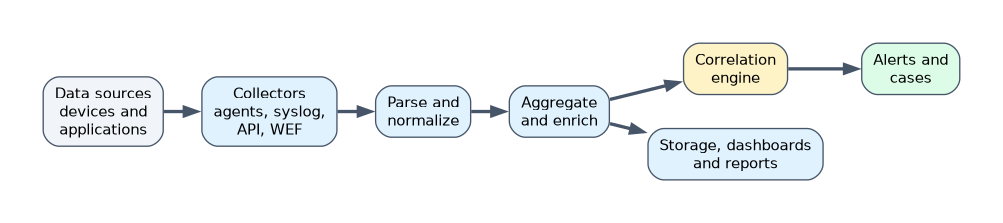 The components below appear in most SIEM designs, whatever the product.
| Component | Role |
|---|---|
| Data sources | Devices and applications that produce logs and events |
| Collectors | Agents on hosts, or agentless collection such as syslog, API pulls and Windows event forwarding |
| Parsing and normalization | Split raw logs into fields and map them to a common schema |
| Aggregation | Combine duplicate or repeated events to reduce volume |
| Enrichment | Add context such as asset owner, user details, geolocation and threat intelligence |
| Correlation engine | Apply rules and analytics across events to find incidents |
| Storage | Keep raw and normalized data for search, reporting and retention |
| Alerting and case handling | Notify analysts and track alerts |
| Dashboards and reports | Show status, trends and compliance results |
Normalization matters because each vendor writes logs differently. One firewall may call a field "src" and another "source address". After normalization, one correlation rule can work on both.
Time synchronization also matters. If devices do not share an NTP source, events from one attack appear out of order and correlation fails.
Types of SIEM solution
| Type | Who runs it | Advantages | Disadvantages |
|---|---|---|---|
| In-house (on premises, self managed) | The organization, on its own hardware | Full control of data and customization; data stays inside | High up front cost, needs skilled staff, scaling is slow |
| Cloud based (SIEM as a service) | Provider hosts the platform; the SOC uses it | Fast to start, scales with volume, no hardware to maintain | Data leaves the site, cost grows with ingestion, less low level control |
| Managed (MSSP) | A managed security service provider runs and monitors it | Access to expert staff and 24x7 coverage at lower cost | Less control, provider may lack business context, dependency on the contract |
| Hybrid or co-managed | Shared between the organization and a provider | Balance of control and expertise; provider covers nights and weekends | Needs clear split of duties and good communication |
The choice depends on budget, staff skills, data residency and compliance rules, log volume, and how much control the organization needs.
A worked example
Contoso has a small security team, no night shift, and a rule that customer data must stay in its own country. It considers a cloud SIEM in a local region, managed by an MSSP that monitors after hours, with Contoso's analysts handling escalations by day.
That is a hybrid or co-managed model. It gives 24x7 coverage without hiring a full night shift, and the region choice answers the residency rule.
How the exam asks about this
- "Which SIEM component converts logs from different vendors into a common format?" → Parsing and normalization.
- "Which SIEM capability links a failed logon on a server with a firewall connection from the same address?" → Correlation.
- "An organization lacks skilled staff and needs 24x7 monitoring at low cost. Which SIEM option fits best?" → A managed SIEM run by an MSSP.
What to remember for the exam
- SIEM = SIM (storage, analysis, reporting) + SEM (real time monitoring, correlation, alerting).
- The data path is collect, parse and normalize, aggregate, enrich, correlate, alert, store.
- Normalization lets one rule work across many vendors' logs.
- In-house gives control but costs most in staff and hardware; cloud scales fast; managed brings expertise; hybrid shares the work.
- Accurate, synchronized time across all sources is a precondition for correlation.
A SIEM that collects everything but has no tuned rules is only an expensive log store. Value comes from the use cases built on top of it.
Common mistakes
Treating SIEM and log management as the same thing. A log manager stores and searches logs. A SIEM adds correlation, alerting and incident context.
Confusing aggregation with correlation. Aggregation combines repeated events to save space. Correlation links different events to reveal an incident.
Assuming a managed SIEM moves all responsibility. The organization still owns its data, its risk and its response decisions.
Check yourself
What does normalization do in a SIEM?
It maps logs from different sources into common fields so the same rules and searches work across all of them.
Which SIEM type gives the most control over data but needs the most in-house staff and hardware?
An in-house, on premises, self managed SIEM.
Why does time synchronization matter for a SIEM?
Correlation relies on event order, so unsynchronized clocks can hide an attack sequence.
Topic 1 of 6 in Incident Detection and Triage
Test yourself on Incident Detection and Triage
The full EC-Council 312-39 question bank has 700 questions, with timed practice exams and an explanation for every answer.
This study guide is independent and is not affiliated with, endorsed by, or sponsored by EC-Council. Vendor names, certification names and exam codes are trademarks of their respective owners and are used for identification only.