Network Defense Management · Topic 3 of 5
Attacker Methodologies and Defense Strategies
Learn the Cyber Kill Chain, MITRE ATT&CK and hacking phases, then the goals of network defense, adaptive security and the layers of defense in depth.
- 5 min
- Includes a diagram
- The kill chain has seven stages, starting with reconnaissance and ending with actions on objectives.
- ATT&CK separates tactics (goal) from techniques (method).
- EC-Council's approach to defense is protect, detect, respond and predict.
What it is
Attackers follow repeatable steps, and frameworks describe those steps so defenders can place controls at each one. Defenders then organize their own work around a strategy: protect, detect, respond and predict, repeated continually, with several layers of control.
The exam asks you to put framework stages in order, state the goal of network defense, and tell adaptive security from defense in depth.
How it works
Attacker methodologies and frameworks
Cyber Kill Chain (Lockheed Martin) has seven stages. Stopping the attacker early breaks the chain.
| Stage | What the attacker does |
|---|---|
| 1. Reconnaissance | Gathers information about the target |
| 2. Weaponization | Builds the malicious payload |
| 3. Delivery | Sends it by email, web or USB |
| 4. Exploitation | Triggers a vulnerability |
| 5. Installation | Installs malware or a backdoor |
| 6. Command and control | Opens a channel back to the attacker |
| 7. Actions on objectives | Steals, damages or spreads |
MITRE ATT&CK is a knowledge base of real attacker tactics (the goal, such as persistence), techniques (how the goal is met) and sub techniques. Defenders map detections to it and use it to find coverage gaps.
Tactics, techniques and procedures (TTPs) describe attacker behavior. Tactics are the why, techniques are the how, and procedures are the specific steps used by one group.
The Diamond Model links four features of an intrusion: adversary, capability, infrastructure and victim.
EC-Council hacking methodology follows these phases: footprinting and reconnaissance, scanning, enumeration, vulnerability analysis, system hacking (gaining access, escalating privileges, maintaining access, clearing tracks).
An adversary behavior view such as TTPs gives a more durable detection than a single IP address, because attackers change addresses easily but change habits slowly.
Goal, benefits and challenges of network defense
The goal of network defense is to keep the network's confidentiality, integrity and availability intact while still letting the business work. EC-Council describes the approach as four activities: protect, detect, respond and predict.
- Benefits: less downtime and data loss, trust from customers, easier compliance, lower recovery cost.
- Challenges: growing attack surface, remote and mobile users, cloud services, shortage of skilled staff, limited budget, unpatched legacy systems, and attackers who need to win only once.
Continual and adaptive security
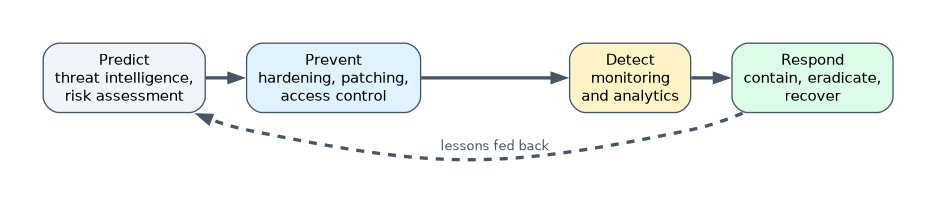 A static defense built once decays as threats change. A continual, adaptive strategy treats security as a cycle that learns from each incident and changes controls.
| Phase | Purpose |
|---|---|
| Predict | Use threat intelligence and risk assessment to anticipate attacks |
| Prevent | Reduce exposure with hardening, patching and access control |
| Detect | Find activity that got through, with monitoring and analytics |
| Respond | Contain, eradicate and recover, then feed lessons back |
Adaptive security uses continuous monitoring and automation, so that a detection can trigger an automatic response such as isolating a host.
Defense in depth
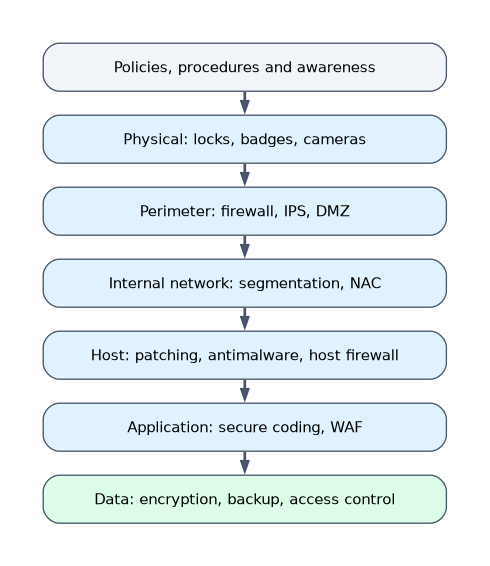 Defense in depth places several independent layers of control between an attacker and the asset. If one fails, another still protects.
| Layer | Example controls |
|---|---|
| Policies, procedures and awareness | Security policy, training |
| Physical | Locks, badges, cameras |
| Perimeter | Firewall, IPS, DMZ |
| Internal network | Segmentation, NAC, internal firewalls |
| Host | Patching, antimalware, host firewall |
| Application | Secure coding, WAF |
| Data | Encryption, backup, access control |
Controls are mixed across three types: administrative (policies), technical (firewalls) and physical (locks). Within each layer, use preventive, detective and corrective controls.
A worked example
A security team maps a ransomware incident to the kill chain. A phishing email (delivery) led to a macro (exploitation) that installed a loader (installation), which called out to a server (command and control).
The team adds mail filtering at delivery, blocks macros at exploitation and uses egress filtering at command and control. Each control sits at a different stage, which is defense in depth, and the lessons loop back into the adaptive cycle.
How the exam asks about this
- "Which Cyber Kill Chain stage involves building the malicious payload?" → Weaponization.
- "Which framework catalogs adversary tactics and techniques from real world observations?" → MITRE ATT&CK.
- "Which strategy uses several independent layers of control?" → Defense in depth.
What to remember for the exam
- The kill chain has seven stages, starting with reconnaissance and ending with actions on objectives.
- ATT&CK separates tactics (goal) from techniques (method).
- EC-Council's approach to defense is protect, detect, respond and predict.
- Adaptive security is a continuous cycle, and defense in depth is a set of layers.
- Defense in depth uses administrative, technical and physical controls together.
Defense in depth is not the same as many copies of one control. Two firewalls of the same type at the same point may add little, because one flaw can defeat both.
Common mistakes
Putting kill chain stages in the wrong order. Weaponization is before delivery, and installation is after exploitation.
Treating adaptive security as a product. It is a strategy of continual monitoring, learning and adjustment, not one tool.
Confusing a tactic with a technique. In ATT&CK, persistence is a tactic, and a specific method such as a scheduled task is a technique.
Check yourself
What is the goal of the delivery stage in the kill chain?
To get the weaponized payload to the target, for example by email or USB.
What four activities make up EC-Council's approach to network defense?
Protect, detect, respond and predict.
Why does defense in depth help?
If one layer fails, other independent layers still protect the asset.
Topic 3 of 5 in Network Defense Management
Test yourself on Network Defense Management
The full EC-Council 312-38 question bank has 800 questions, with timed practice exams and an explanation for every answer.
This study guide is independent and is not affiliated with, endorsed by, or sponsored by EC-Council. Vendor names, certification names and exam codes are trademarks of their respective owners and are used for identification only.