Design Applications · Topic 2 of 2
Tools, Multi-Stage Reasoning and Agent Bricks
Databricks GenAI Engineer: choose and order agent tools for multi-stage reasoning, and when Knowledge Assistant, Supervisor or Information Extraction fits.
- 6 min
- Includes a diagram
- Knowledge tools gather information; action tools change something and need extra care.
- Order tools by data dependency: identify, look up, verify, then act.
- Unity Catalog function and parameter COMMENTs are what the LLM reads to choose and call a tool.
What it is
An agent is an LLM that decides which tools to call, reads the results and decides the next step until it can answer. Tools either gather knowledge (search documents, query a table) or take actions (create a ticket, send a message).
Agent Bricks builds common agent types for you from a description and your data, without writing the orchestration code. The exam names three: Knowledge Assistant, Multiagent Supervisor and Information Extraction.
How it works
Tools that gather knowledge
| Need | Tool on Databricks |
|---|---|
| Answer from unstructured documents | Vector Search index used as a retriever |
| Answer from tables in plain language | A Genie space |
| Run governed SQL or Python logic | A Unity Catalog function |
| Reach tools that another system exposes | An MCP server (managed, external or custom) |
A Unity Catalog function becomes a tool with its name, its COMMENT and its parameter COMMENTs. Those comments are the tool and argument descriptions the LLM sees, so vague comments lead to wrong tool choices or bad arguments.
An MCP server lists its tools with input schemas, and the agent discovers them at run time. Databricks offers managed MCP servers (for example for Vector Search, Genie spaces and Unity Catalog functions), external MCP servers through connections, and custom MCP servers hosted as Databricks Apps.
Tools that take actions
Action tools change something outside the agent, such as updating a record or calling an external API.
Because actions have side effects, give them precise descriptions and narrow inputs. For irreversible actions, the design should confirm details or ask for human approval first.
Ordering tools for multi-stage reasoning
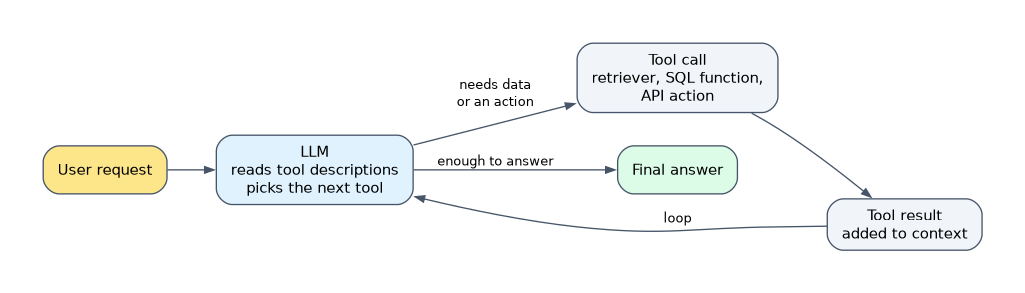 A multi-stage task has dependencies. A later step needs the output of an earlier one, so the order follows the data.
| Rule | Example |
|---|---|
| Gather before you act | Look up the order status before issuing a refund |
| Identify before you look up | Find the customer ID before querying their orders |
| Verify before irreversible steps | Confirm the amount before calling the payment tool |
The LLM loops: it picks a tool, reads the result and picks the next one. Clear descriptions and a system prompt that states the intended order help it choose correctly.
Agent Bricks: the three agent types
| Agent type | What it does | Fits when |
|---|---|---|
| Knowledge Assistant | A question and answer chatbot over your documents that cites its sources | Staff need answers from manuals, policies or reports |
| Multiagent Supervisor | Coordinates several agents and tools, such as Genie spaces, agent endpoints, Unity Catalog functions and MCP servers | One request spans documents, tables and actions |
| Information Extraction | Turns unstructured documents into structured records that follow a schema you approve | You need fields such as dates, parties and amounts as table columns |
Knowledge Assistant takes documents from Unity Catalog volumes (and other supported sources), handles retrieval for you and returns answers with citations. You improve it with labeled example questions and guidelines from subject matter experts, not by rewriting code.
Multiagent Supervisor routes each request using the descriptions of the agents and tools you add, then combines their results. End users reach only the subagents and data they have permission to use. It is called Supervisor Agent in newer docs, which mark it and Knowledge Assistant as legacy offerings and recommend Genie Agents for new low-code agents, but the exam guide still tests both by these names.
Information Extraction reads documents from a volume or a text column in a table and returns JSON per document, following a schema of fields with names, types and descriptions. The current version also runs from SQL through ai_extract.
Agent Bricks or custom Agent Framework
| Choose Agent Bricks when | Choose custom Mosaic AI Agent Framework code when |
|---|---|
| The task matches one of the agent types | The logic does not match any agent type |
| You want a working agent quickly with little code | You need fine control of prompts, steps and tools |
| Quality is tuned with examples and expert feedback | You need a custom orchestration library or flow |
How the exam asks about this
- "HR staff need answers from policy PDFs with links to the source, built quickly with little code." Use Knowledge Assistant.
- "Extract supplier, date and total from thousands of invoices into a table." Use Information Extraction.
- "One assistant must answer sales questions from tables and product questions from documents." Use Multiagent Supervisor with a Genie space and a Knowledge Assistant as subagents.
What to remember for the exam
- Knowledge tools gather information; action tools change something and need extra care.
- Order tools by data dependency: identify, look up, verify, then act.
- Unity Catalog function and parameter COMMENTs are what the LLM reads to choose and call a tool.
- MCP clients discover tools and their input schemas from the server at run time.
- Knowledge Assistant answers from documents with citations; Information Extraction outputs structured fields.
- Multiagent Supervisor routes by the descriptions of its subagents and tools.
Do not pick Information Extraction for a chatbot or Knowledge Assistant for filling table columns. Match the output: answers with citations, structured records, or a coordinated result across several sources.
Common mistakes
Calling the action tool first. Acting before gathering facts leads to wrong refunds or updates. The design should gather and verify, then act.
Leaving tool descriptions empty. The LLM chooses tools from their descriptions. An uncommented Unity Catalog function is often ignored or called with wrong arguments.
Writing custom code for a standard pattern. A document chatbot or a field extractor is exactly what Agent Bricks builds. Custom Agent Framework code is for logic the agent types do not cover.
Check yourself
Where does an agent's LLM get the description of a Unity Catalog function tool?
From the function COMMENT and its parameter COMMENTs, which serve as the tool and argument descriptions.
An agent must cancel a subscription only if the account has no open invoices. What order should the tools run in?
Look up the account, check open invoices with a knowledge tool, then call the cancel action only if the check passes.
Which Agent Bricks type fits turning contracts into rows with fixed fields?
Information Extraction, which returns structured JSON per document following an approved schema.
Topic 2 of 2 in Design Applications
Test yourself on Design Applications
The full Databricks Generative AI Engineer Associate question bank has 600 questions, with timed practice exams and an explanation for every answer.
This study guide is independent and is not affiliated with, endorsed by, or sponsored by Databricks. Vendor names, certification names and exam codes are trademarks of their respective owners and are used for identification only.