Governance and Security · Topic 1 of 2
Managed and External Tables and Privileges
Databricks DEA Unity Catalog: managed vs external tables, DROP and UNDROP, SET MANAGED, privilege inheritance, GRANT, REVOKE and why DENY is legacy only.
- 5 min
- Includes a diagram
- Managed tables live in managed storage; DROP deletes their data. External tables use
LOCATION; DROP leaves the files. UNDROP TABLErecovers a dropped table within 7 days by default.SET MANAGEDconverts external to managed;UNSET MANAGEDrolls back within 14 days.
What it is
Every Unity Catalog table is either managed or external. The difference is who controls the data files: Unity Catalog, or you through a path you supply.
Access to any table is controlled by privileges granted to principals: users, groups and service principals. Privileges follow the hierarchy metastore, catalog, schema, table, and a grant at one level is inherited by everything below it.
How it works
Managed and external tables
| Managed table | External table | |
|---|---|---|
| Storage | Managed storage location of the metastore, catalog or schema | A path you give with LOCATION, inside an external location |
| Formats | Delta Lake (and Iceberg) | Delta Lake and other formats such as Parquet, CSV, JSON |
| DROP TABLE | Removes the table and its data | Removes only the metadata; the files stay |
| Predictive optimization | Yes | No |
| Typical use | Default for new tables | Data that other tools must read or write at a fixed path |
Databricks recommends managed tables by default. Unity Catalog then handles the file lifecycle and maintenance.
CREATE TABLE main.sales.orders (id BIGINT, amount DECIMAL(10,2));
CREATE TABLE main.sales.orders_ext (id BIGINT, amount DECIMAL(10,2))
LOCATION 's3://acme-data/sales/orders';
The external table needs an external location covering that path, backed by a storage credential. Creating it needs CREATE EXTERNAL TABLE on the external location.
Modifying and deleting
Both types use the same DDL to modify: ALTER TABLE ... ADD COLUMN, RENAME TO, SET TBLPROPERTIES and OWNER TO. Delta operations such as INSERT, MERGE and OPTIMIZE work on both.
DROP TABLE on a managed table deletes the data as well. UNDROP TABLE recovers a dropped Unity Catalog table within the retention window, 7 days by default.
Converting between types
An external Delta table converts to managed in place, without recreating it.
ALTER TABLE main.sales.orders_ext SET MANAGED;
ALTER TABLE main.sales.orders_ext UNSET MANAGED;
SET MANAGED copies the data into managed storage and switches the table; it needs table ownership and Databricks Runtime 17.3 LTS or above, or serverless compute. UNSET MANAGED rolls the conversion back within 14 days.
There is no documented command that turns a managed table into an external one; UNSET MANAGED only rolls back a recent SET MANAGED. Otherwise, copy the data into a new external table at a LOCATION path, then drop the managed table.
The privilege hierarchy
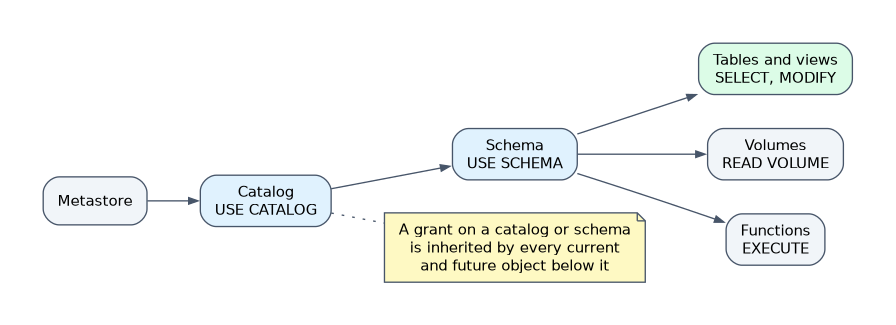 To query a table, a principal needs all three levels.
| Level | Privilege needed to read |
|---|---|
| Catalog | USE CATALOG |
| Schema | USE SCHEMA |
| Table | SELECT |
Other common privileges are MODIFY (insert, update, delete), CREATE SCHEMA, CREATE TABLE, EXECUTE on functions, MANAGE (grant privileges on the object) and ALL PRIVILEGES. Grant SELECT on a schema and the principal can read every current and future table in it.
GRANT and REVOKE
GRANT USE CATALOG ON CATALOG main TO `analysts`;
GRANT USE SCHEMA, SELECT ON SCHEMA main.sales TO `analysts`;
GRANT MODIFY ON TABLE main.sales.orders TO `<sp-application-id>`;
REVOKE SELECT ON SCHEMA main.sales FROM `analysts`;
SHOW GRANTS ON TABLE main.sales.orders;
Names with special characters go in backticks, and a service principal is named by its application ID. Grant to groups rather than individual users, so access follows team membership.
In the UI, open the object in Catalog Explorer, select the Permissions tab and choose Grant. The owner, the owner of the containing catalog or schema, a user with MANAGE and a metastore admin can grant.
What about DENY
Unity Catalog has no DENY statement. Access is denied unless a privilege is granted, so you remove access with REVOKE.
The SQL DENY command applies only to the legacy hive_metastore catalog and its table access control. Unity Catalog also offers ABAC DENY policies, in Beta, which deny only the MANAGE ACCESS CONTROL privilege on tagged objects.
How the exam asks about this
- "Dropping the table must not delete the files that another tool reads." Use an external table with
LOCATION. - "Analysts must read every table in the sales schema, including future ones." Grant
USE CATALOGon the catalog, andUSE SCHEMAandSELECTon the schema, to the group. - "Move an external Delta table under Unity Catalog management without rewriting jobs."
ALTER TABLE ... SET MANAGED.
What to remember for the exam
- Managed tables live in managed storage; DROP deletes their data. External tables use
LOCATION; DROP leaves the files. UNDROP TABLErecovers a dropped table within 7 days by default.SET MANAGEDconverts external to managed;UNSET MANAGEDrolls back within 14 days.- Reading a table needs
USE CATALOG,USE SCHEMAandSELECT. - Grants are inherited downward; grant to groups and service principals, not individuals.
- Unity Catalog has no DENY statement; use
REVOKE.
An answer that uses DENY SELECT to block a user on a Unity Catalog table is wrong. DENY is a legacy Hive metastore command; in Unity Catalog, revoke the grant or restrict rows and columns with filters and masks.
Common mistakes
Granting SELECT on the table only. Without USE CATALOG and USE SCHEMA on the parents, the user still cannot query it.
Assuming DROP of an external table frees storage. The files remain in cloud storage until someone deletes them.
Granting to individual users. Every joiner and leaver then needs new grants. Grant to a group and manage membership.
Check yourself
What happens to the data files when you drop an external table?
They stay in cloud storage; only the table's metadata is removed from Unity Catalog.
Which privileges does a group need to query main.sales.orders?
USE CATALOG on main, USE SCHEMA on main.sales and SELECT on the table or on the schema.
How do you take away a privilege in Unity Catalog?
With REVOKE, because Unity Catalog has no DENY statement and access exists only where a privilege is granted.
Topic 1 of 2 in Governance and Security
Test yourself on Governance and Security
The full Databricks Data Engineer Associate question bank has 598 questions, with timed practice exams and an explanation for every answer.
This study guide is independent and is not affiliated with, endorsed by, or sponsored by Databricks. Vendor names, certification names and exam codes are trademarks of their respective owners and are used for identification only.