Security Architecture · Topic 6 of 6
Resilience and Recovery Planning
Security+ resilience and recovery: high availability, hot warm cold sites, RTO and RPO, backup types, power, testing and continuity planning.
- 4 min
- Includes a diagram
- Hot, warm and cold sites trade cost against recovery speed.
- RTO is how long recovery may take, and RPO is how much data loss is acceptable.
- Load balancing and clustering provide high availability.
What it is
Resilience is the ability to keep working through a failure or attack. Recovery is the ability to return to normal afterward.
Both depend on planning ahead. The aim is to design systems so that one failed component, site or provider does not stop the business.
How it works
High availability
High availability (HA) keeps a service running with little or no downtime.
| Technique | Description |
|---|---|
| Load balancing | Spreads traffic over several servers |
| Clustering | Several servers act as one system and take over from each other |
| Redundancy | Spare components, such as power supplies and network links |
In an active/active design, all nodes handle traffic. In an active/passive design, a standby node waits to take over.
Site considerations
A recovery site is an alternate location that can host operations.
| Site | State | Recovery speed | Cost |
|---|---|---|---|
| Hot | Fully equipped and running, with current data | Fastest | Highest |
| Warm | Equipment ready, data and setup need work | Moderate | Moderate |
| Cold | Space and power only | Slowest | Lowest |
Geographic dispersion places sites far enough apart that one disaster does not affect both. Platform diversity uses different technologies so that a single flaw does not hit everything. Multi cloud spreads workloads across providers to reduce reliance on one.
Recovery targets
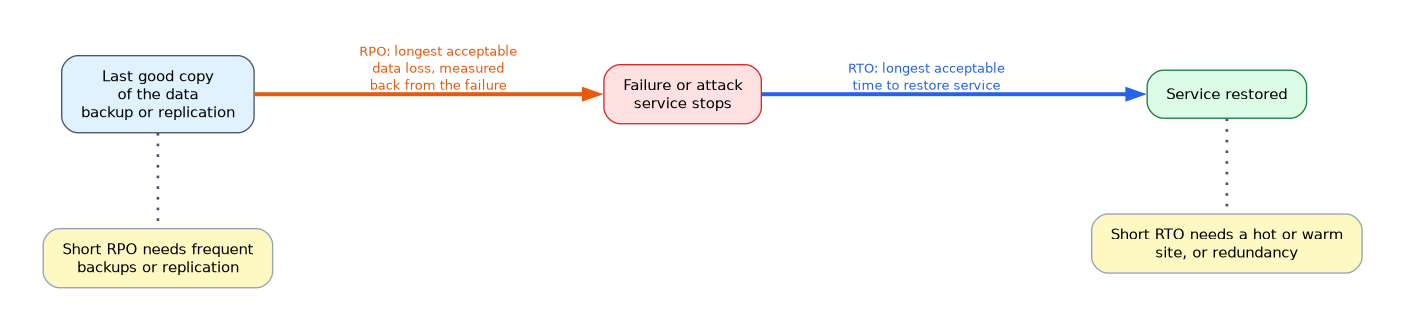 Two numbers guide the design. The recovery time objective (RTO) is the longest acceptable time to restore service. The recovery point objective (RPO) is the longest acceptable span of data loss, measured back from the failure.
A short RPO needs frequent backups or replication. A short RTO needs a hot or warm site, or redundancy.
Backups
| Concept | Meaning |
|---|---|
| Full backup | Copies all selected data |
| Incremental | Copies only what changed since the last backup of any kind |
| Differential | Copies what changed since the last full backup |
| Snapshot | A point in time image of a system or volume |
| Replication | Copies data to another system continually or on a schedule |
| Journaling | Records changes so that they can be replayed or undone |
| Onsite and offsite | Local copies recover fast, and offsite copies survive a site disaster |
Backups should be encrypted and tested by restoring. A backup that has never been restored is an assumption, not a plan. One copy should be offline or unchangeable, to survive ransomware.
Power
An uninterruptible power supply (UPS) bridges short outages and gives time for a clean shutdown or generator start. A generator supplies long term power. Dual power feeds add further protection.
Testing and continuity
| Test | What it does |
|---|---|
| Tabletop exercise | Participants talk through a scenario |
| Failover test | Switches to the standby system to confirm it works |
| Simulation | Runs a realistic scenario with actions |
| Parallel processing | Runs the recovery system alongside the live one to compare results |
Continuity of operations planning describes how essential functions continue during and after a disruption. Capacity planning checks that people, technology and infrastructure can support the plan.
What to remember for the exam
- Hot, warm and cold sites trade cost against recovery speed.
- RTO is how long recovery may take, and RPO is how much data loss is acceptable.
- Load balancing and clustering provide high availability.
- A differential backup copies changes since the last full backup. An incremental copies changes since the last backup.
- Keep at least one backup offsite, and test restores.
- A UPS covers short outages and a generator covers long ones.
- A tabletop exercise discusses a scenario, while a failover test actually switches systems.
- Geographic dispersion protects against a regional disaster.
For an RPO question, ask how much data the business can afford to lose. The answer sets how often to back up or replicate.
Common mistakes
Mixing RTO and RPO. RTO is about time to restore service. RPO is about the age of the data you can recover to.
Confusing incremental and differential. Incremental is relative to the last backup of any kind, while differential is relative to the last full backup.
Assuming replication replaces backup. Replication copies mistakes and ransomware too, so keep separate backups.
Never testing the plan. Untested recovery plans often fail because of missing steps, old contacts or broken backups.
Choosing a hot site for every system. It is the most costly option, and less critical systems can use a warm or cold site.
A backup stored on the same network with write access can be encrypted along with live data, so protect at least one copy.
Check yourself
What does the recovery point objective measure?
The maximum acceptable amount of data loss, expressed as time back from the failure.
Which recovery site is fastest and most expensive?
A hot site.
How does a differential backup differ from an incremental backup?
A differential copies everything changed since the last full backup, while an incremental copies only what changed since the last backup of any type.
Topic 6 of 6 in Security Architecture
Test yourself on Security Architecture
The full CompTIA Security+ SY0-701 question bank has 848 questions, with timed practice exams and an explanation for every answer.
This study guide is independent and is not affiliated with, endorsed by, or sponsored by CompTIA. Vendor names, certification names and exam codes are trademarks of their respective owners and are used for identification only.