Basic Network Security Concepts · Topic 1 of 7
TCP/IP Protocol Vulnerabilities
Learn the security weaknesses of TCP, UDP, HTTP, ARP, ICMP, DHCP and DNS, the attacks that abuse them, and the simple controls that reduce each risk.
- 6 min
- Includes a diagram
- A SYN flood leaves TCP handshakes half finished and uses up server resources.
- UDP has no handshake, so it is easy to spoof and to use in amplification attacks.
- HTTP is plaintext, and HTTPS adds TLS encryption.
What it is
Many everyday network protocols were designed for speed and ease of use, not for security.
Because they trust the information they receive, attackers can abuse them. The weakness is in the design, so the fix is usually a control placed around the protocol.
This page looks at seven protocols and, for each one, the typical attack and the typical defence.
How it works
Each protocol has a trusting step that an attacker can fake or flood.
TCP and UDP
TCP sets up a connection with a three step handshake. The client sends a SYN, the server replies with a SYN and ACK, and the client sends an ACK.
In a SYN flood, the attacker sends many SYN packets and never finishes the handshake. The server keeps half open connections waiting until its resources run out, so real users are refused. TCP can also suffer from session hijacking, where an attacker takes over an established connection.
UDP has no handshake and no connection state. That makes it fast, but it is easy to spoof the source address and to use for floods. Attackers can send small requests with a fake source address so that a much larger reply goes to the victim, which is an amplification attack.
HTTP, ARP and ICMP
| Protocol | Weakness | Typical attack | Defence |
|---|---|---|---|
| HTTP | Sends everything in plaintext | Eavesdropping, tampering, stolen logins | Use HTTPS |
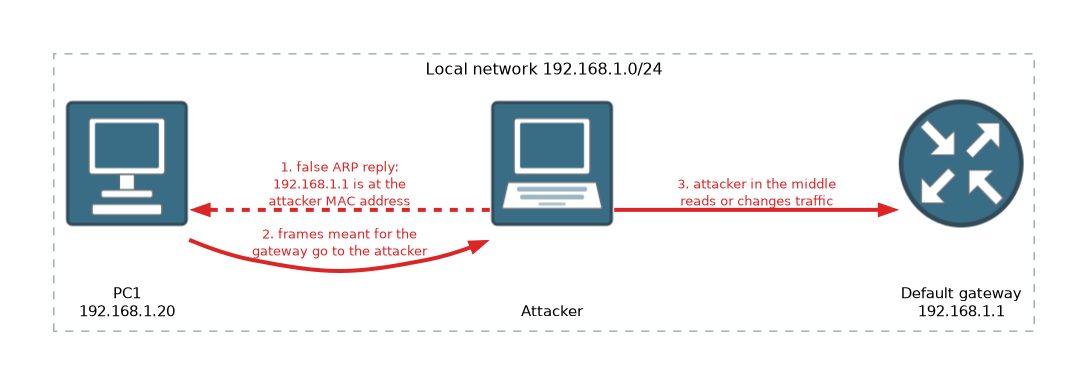
| ARP | Accepts replies nobody asked for, with no check | ARP spoofing or poisoning | Dynamic ARP inspection, segmentation |
| ICMP | Reveals which hosts exist and can be flooded | Ping sweeps, ICMP flood | Filter unneeded ICMP types |
HTTP carries web traffic with no encryption, so anyone on the path can read it. HTTPS wraps HTTP in TLS to fix this. Web applications can also be attacked through the input they accept, such as in injection attacks, so input must be validated.
ARP maps an IP address to a MAC address on a local network. In ARP poisoning, the attacker sends false ARP replies that link the attacker's MAC address to another host's IP address, often the default gateway. The victim then sends frames to the attacker, which makes a man in the middle position possible.
ICMP is used by ping and for error messages. Attackers use it to find live hosts in a ping sweep, and to flood a target. Many networks allow only the ICMP types they really need.
C:\> arp -a
Interface: 192.168.1.20 --- 0x4
  Internet Address      Physical Address      Type
  192.168.1.1           aa-bb-cc-dd-ee-01     dynamic
If two different IP addresses show the same MAC address in the ARP table, ARP poisoning is a possible cause.
DHCP
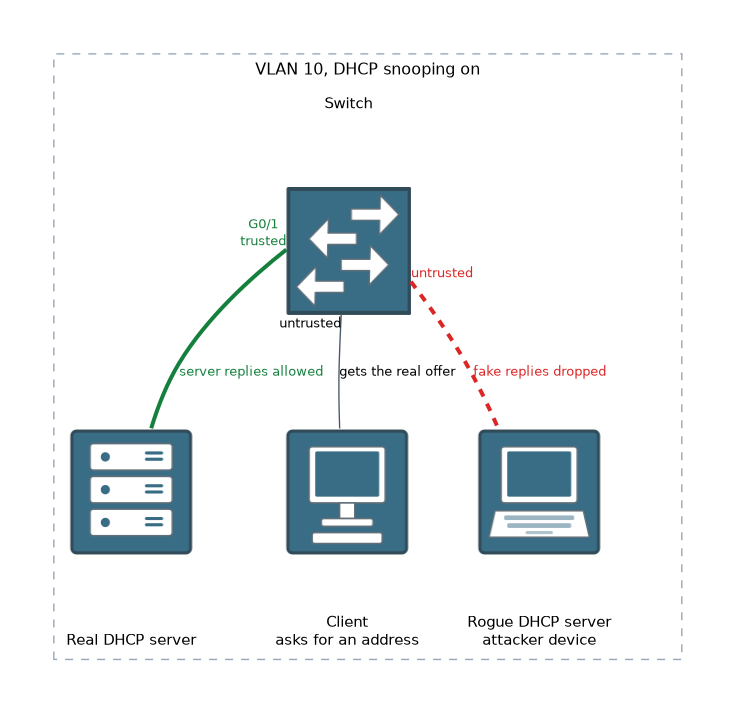 DHCP hands out IP addresses, the default gateway and the DNS server to clients. Clients accept the first offer they hear.
- In a rogue DHCP server attack, a fake server gives clients a gateway or DNS server that the attacker controls.
- In DHCP starvation, the attacker requests all the addresses in the pool, so real clients get none.
On Cisco switches the defence is DHCP snooping. It marks ports as trusted or untrusted and only allows DHCP server replies from trusted ports.
Switch(config)# ip dhcp snooping
Switch(config)# ip dhcp snooping vlan 10
Switch(config)# interface GigabitEthernet0/1
Switch(config-if)# ip dhcp snooping trust
The last two commands mark one port as trusted. Use them on the port that faces the real DHCP server or the uplink toward it.
DNS
DNS turns names such as a website name into IP addresses. It is a favourite target because everything starts with a lookup.
- DNS spoofing or cache poisoning places a false answer in a resolver, so users are sent to a fake site.
- DNS tunnelling hides other data inside DNS queries to sneak it past controls.
- A DNS flood can make the service unavailable.
Defences include DNSSEC, which signs DNS data so that answers can be verified, using trusted resolvers, and monitoring for unusual query patterns.
What to remember for the exam
Seven facts cover most questions on this topic.
- A SYN flood leaves TCP handshakes half finished and uses up server resources.
- UDP has no handshake, so it is easy to spoof and to use in amplification attacks.
- HTTP is plaintext, and HTTPS adds TLS encryption.
- ARP poisoning links an attacker's MAC address to another host's IP address.
- ICMP is used for ping sweeps and floods.
- DHCP snooping blocks rogue DHCP servers by trusting only certain ports.
- DNS cache poisoning sends users to fake sites, and DNSSEC helps verify answers.
Ask what the protocol trusts. TCP trusts the handshake, ARP trusts any reply, and DHCP trusts the first offer.
Common mistakes
These four errors are common.
Blaming the protocol only. Attacks work because of missing controls around the protocol, so the answer is usually a switch feature, a filter or encryption.
Thinking HTTPS fixes everything. HTTPS protects data in transit, but the web application can still have flaws.
Mixing up DHCP starvation and a rogue server. Starvation uses up the pool, and a rogue server gives out harmful settings.
Blocking all ICMP without thought. Some ICMP messages are needed for normal network operation, so filter by type.
A rogue DHCP server can redirect all of a client's traffic without any warning to the user.
Check yourself
Work through these three questions.
What does a SYN flood do to a server?
It sends many SYN packets and never finishes the handshake. The half open connections use up the server's resources.
What is ARP poisoning?
It is sending false ARP replies that link the attacker's MAC address to another host's IP address, often the default gateway. This can place the attacker in the middle.
Which Cisco switch feature helps stop a rogue DHCP server?
DHCP snooping. It only accepts DHCP server replies from ports marked as trusted.
Topic 1 of 7 in Basic Network Security Concepts
Test yourself on Basic Network Security Concepts
The full Cisco CCST 100-160 Cybersecurity question bank has 864 questions, with timed practice exams and an explanation for every answer.
This study guide is independent and is not affiliated with, endorsed by, or sponsored by Cisco. Vendor names, certification names and exam codes are trademarks of their respective owners and are used for identification only.