Security Policies and Procedures · Topic 2 of 7
NIST SP 800-61 Incident Response
Learn the elements of an incident response plan in NIST SP 800-61 and the four phases of incident handling, and map actions to each phase of the cycle.
- 5 min
- Includes a diagram
- The four phases are preparation, detection and analysis, containment, eradication and recovery, and post incident activity.
- Preparation includes the plan, the team, tools, training and contacts.
- Precursors suggest an incident may happen, and indicators show one is happening or has happened.
What it is
NIST SP 800-61 is a guide to handling computer security incidents, and its four phase process is the model the exam uses.
NIST has also published a newer revision that organises the work differently, but the four phase names below are the ones the exam outline lists.
An incident response plan sets out how the organisation prepares for, finds, handles and learns from incidents. The phases give the team a common order of work and a common language.
Questions ask you to name the phase of a described action, to list what a plan contains, and to apply the process to a short story.
How it works
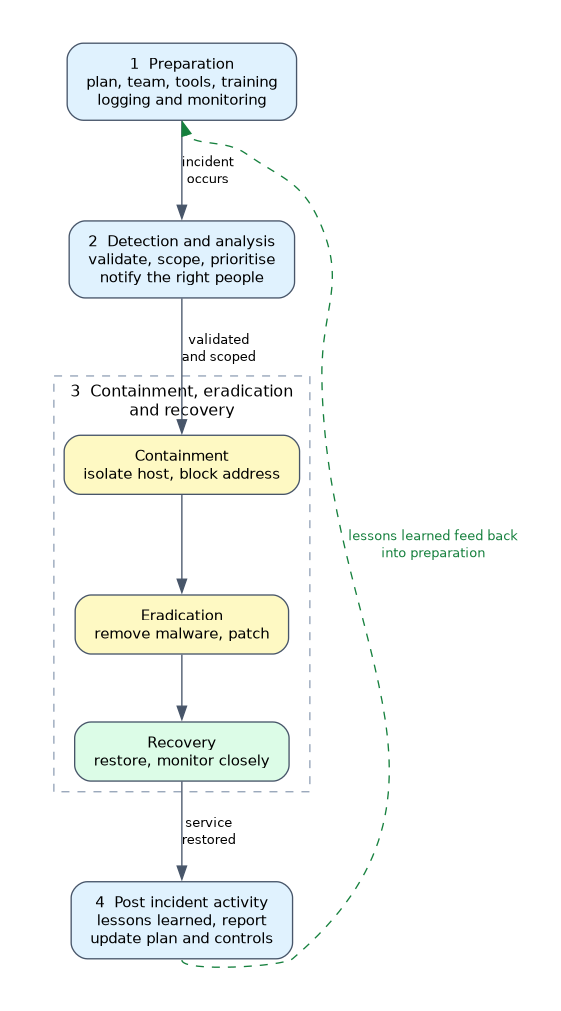 The phases form a cycle, and lessons from the last phase improve the first.
Elements of an incident response plan
A plan should be approved by senior management, and it typically covers:
- The mission of incident response
- Strategies and goals for how the organisation will respond
- The organisational approach to incident response
- How the team communicates inside and outside the organisation
- Metrics to measure the response capability
- A roadmap for maturing the capability over time
- How the programme fits into the wider organisation
The related policy states management commitment, purpose, scope and the definition of an incident. It also sets roles and authority, severity ratings for incidents, and how incidents are reported.
Phase 1: Preparation
Preparation happens before any incident. It builds the capability.
- Write the policy and plan, and form the response team
- Prepare tools, such as analysis workstations, forensic software and a secure place to store evidence
- Prepare contact lists, including management, legal and external parties
- Train staff and run exercises
- Secure the systems with patching, logging and monitoring, so that fewer incidents occur
Phase 2: Detection and analysis
This phase finds out that something has happened and what it is.
- Collect precursors, which are signs that an incident may happen, and indicators, which are signs that one has happened or is happening
- Use alerts, logs, user reports and threat intelligence
- Validate the alert to rule out a false positive
- Scope the incident to see which systems and data are affected
- Prioritise by impact and document everything with times and actions
- Notify the right people
Common sources of incidents are grouped as attack vectors, such as removable media, web, email, impersonation, improper use by staff, and loss or theft of equipment.
Phase 3: Containment, eradication and recovery
This phase stops the harm and returns to normal operation.
| Step | Goal | Examples |
|---|---|---|
| Containment | Stop the incident from spreading or causing more harm | Isolate a host, disable an account, block an address |
| Eradication | Remove the cause | Delete malware, close the weakness, patch the system |
| Recovery | Restore normal service safely | Rebuild from a clean image, restore data, monitor closely |
Before containing, the team decides on a strategy. It considers the damage, the need to preserve evidence, the effect on services and how long the measure will last. Evidence should be collected before a system is wiped.
Phase 4: Post incident activity
After the incident, the team holds a lessons learned meeting. It asks what happened, how well the team and the plan worked, what was missed, and what should change.
The outputs include a report, updates to the plan and controls, and data for metrics. Evidence is kept according to a retention policy. This phase feeds back into preparation.
Applying the process to an event
A user reports a strange email, and the mail logs show that several staff received it. The steps follow the phases.
- The report and logs are detection and analysis. The team confirms the email is malicious and finds which mailboxes were hit.
- Blocking the sender and isolating a host that clicked is containment.
- Removing the malware and resetting passwords is eradication.
- Restoring the host and watching it is recovery.
- The review meeting and the update to training is post incident activity.
What to remember for the exam
Seven facts cover most questions on this topic.
- The four phases are preparation, detection and analysis, containment, eradication and recovery, and post incident activity.
- Preparation includes the plan, the team, tools, training and contacts.
- Precursors suggest an incident may happen, and indicators show one is happening or has happened.
- Detection and analysis includes validating, scoping and prioritising.
- Containment stops the spread, eradication removes the cause, and recovery restores service.
- Lessons learned belongs to post incident activity.
- Evidence should be preserved before systems are wiped.
Ask whether the action happens before, during or after the incident. Before is preparation, and after is post incident activity.
Common mistakes
These four errors appear often.
Eradicating before containing. Removing malware while the attack is still spreading may not stop it.
Skipping validation. A false positive wastes the response effort.
Wiping a system before collecting evidence. Evidence may be lost.
Treating lessons learned as optional. It is how the plan improves.
Containment, eradication and recovery are three activities that form a single phase in this model.
Check yourself
Work through these three questions.
What are the four phases of NIST SP 800-61 incident handling?
Preparation, detection and analysis, containment, eradication and recovery, and post incident activity.
What is the difference between a precursor and an indicator?
A precursor suggests an incident may happen in future. An indicator shows that one is happening or has happened.
In which phase does a lessons learned meeting belong?
Post incident activity, which is the last phase and feeds back into preparation.
Topic 2 of 7 in Security Policies and Procedures
Test yourself on Security Policies and Procedures
The full Cisco CCNA 200-201 CBROPS question bank has 754 questions, with timed practice exams and an explanation for every answer.
This study guide is independent and is not affiliated with, endorsed by, or sponsored by Cisco. Vendor names, certification names and exam codes are trademarks of their respective owners and are used for identification only.