Security Monitoring · Topic 8 of 8
Certificates, PKI and TLS Components
Understand how PKI and certificates secure traffic, how asymmetric and symmetric keys work together, and the parts of X.509 certificates and TLS suites.
- 5 min
- Includes a diagram
- A certificate binds a public key to an identity and is signed by a CA.
- Asymmetric keys handle identity and key exchange. Symmetric keys encrypt the data.
- The private key stays secret and is not sent over the network.
What it is
A digital certificate ties a public key to an identity, and public key infrastructure (PKI) is the system that issues and trusts those certificates.
When a browser connects to a secure website, it needs to know that the server is who it claims to be. The certificate, signed by a trusted authority, gives that proof.
After that, the two sides agree on keys to encrypt the session. Analysts read certificate and handshake details to judge whether a connection is trustworthy.
How it works
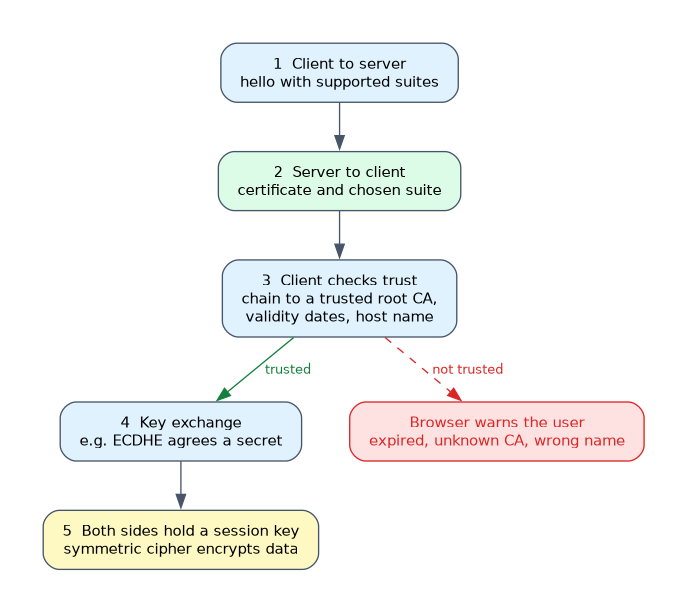
Asymmetric keys prove identity and agree a secret, then a symmetric key does the fast bulk encryption.
Asymmetric and symmetric keys
| Type | Keys | Speed | Use |
|---|---|---|---|
| Asymmetric | A public and private pair | Slower | Signatures, identity, key exchange |
| Symmetric | One shared secret key | Fast | Encrypting the data itself |
What the public key encrypts, only the private key can decrypt. The private key stays with its owner and is not sent across the network. A signature made with the private key can be checked by anyone using the public key.
Real sessions use both. Asymmetric methods establish trust and a shared secret, then a symmetric cipher encrypts the traffic.
PKI
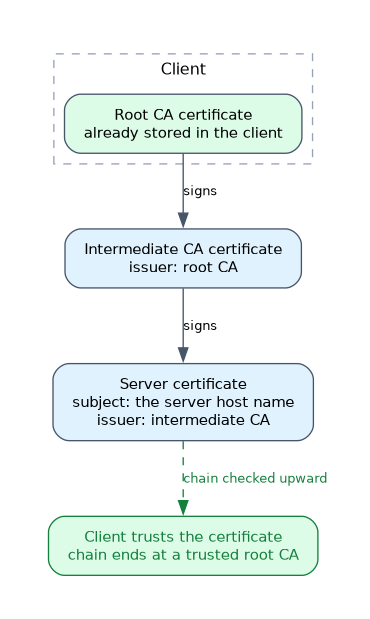 A certificate authority (CA) is a trusted organisation that signs certificates. A client trusts a certificate if it is signed by a CA the client trusts, directly or through a chain of intermediate CAs. The chain ends at a root CA, whose certificate is already stored in the client.
If a certificate is expired, signed by an unknown CA, or issued for another name, the client warns the user. A CA can also publish a revocation list or answer status queries so that stolen certificates can be rejected.
X.509 certificates
X.509 is the standard format of the certificates used on the web. A certificate holds fields such as:
- Version and serial number
- Signature algorithm
- Issuer, which is the CA that signed it
- Validity dates, showing not before and not after
- Subject, which is the owner of the certificate
- Subject public key information, which holds the public key
- Extensions, such as the subject alternative names that list the valid host names
A self signed certificate has the same issuer and subject. It is not trusted by default.
openssl x509 -in server.pem -text -nooutThat command prints the fields of a certificate file so you can read them.
Cipher suite, key exchange and protocol version
A cipher suite is a named set of algorithms for one secure session. In TLS 1.2 the name lists the key exchange, the authentication method, the bulk cipher and the hash.
TLS_ECDHE_RSA_WITH_AES_256_GCM_SHA384- ECDHE is the key exchange, which agrees a shared secret.
- RSA is the authentication method, tied to the certificate key.
- AES_256_GCM is the symmetric cipher.
- SHA384 is the hash algorithm the suite uses.
The key exchange uses ephemeral keys in the DHE and ECDHE forms. This gives forward secrecy, which means a later theft of the server key does not expose past sessions.
The protocol version matters because older versions have known weaknesses. SSL and early TLS versions are deprecated. TLS 1.2 and TLS 1.3 are the versions in common use.
TLS 1.3 suite names are shorter, so a name such as TLS_AES_256_GCM_SHA384 lists only the cipher and the hash, not the key exchange.
PKCS
PKCS stands for Public Key Cryptography Standards, a set of formats and rules. Two you are likely to meet are:
- PKCS #10, the format of a certificate signing request sent to a CA.
- PKCS #12, a file that bundles a certificate with its private key, usually protected by a password.
What to remember for the exam
Seven facts cover most questions on this topic.
- A certificate binds a public key to an identity and is signed by a CA.
- Asymmetric keys handle identity and key exchange. Symmetric keys encrypt the data.
- The private key stays secret and is not sent over the network.
- A client trusts a certificate when it chains to a trusted root CA.
- X.509 fields include issuer, subject, validity and the public key.
- A cipher suite names the key exchange, authentication, cipher and hash.
- PKCS #10 is a signing request, and PKCS #12 bundles a certificate and private key.
In a TLS 1.2 suite name, read left to right. Key exchange comes first, then authentication, then the cipher, then the hash.
Common mistakes
These four errors appear often.
Mixing up the keys. The public key is shared, and the private key is kept secret.
Using asymmetric encryption for all the data. It is too slow, so a symmetric key is used for the session.
Trusting a self signed certificate by default. Its issuer and subject match, and no trusted CA has vouched for it.
Ignoring the protocol version. Old versions are deprecated because of known weaknesses.
A PKCS #12 file contains a private key, so treat it like a password and protect it.
Check yourself
Work through these three questions.
Why do sessions use both asymmetric and symmetric keys?
Asymmetric keys prove identity and agree a secret. A symmetric key then encrypts the data quickly.
What does a client check to decide whether to trust a certificate?
It checks that the certificate chains to a trusted root CA, is within its validity dates and matches the host name.
What does the ECDHE part of a cipher suite name tell you?
It is the key exchange, which agrees a shared secret and gives forward secrecy.
Topic 8 of 8 in Security Monitoring
Test yourself on Security Monitoring
The full Cisco CCNA 200-201 CBROPS question bank has 754 questions, with timed practice exams and an explanation for every answer.
This study guide is independent and is not affiliated with, endorsed by, or sponsored by Cisco. Vendor names, certification names and exam codes are trademarks of their respective owners and are used for identification only.