Testing, Validation, and Troubleshooting · Topic 3 of 6
Quality Gates, Deployment Validation and Reporting
Keep FM quality stable with continuous evaluation, regression tests and quality gates, check updates for hallucination and drift, and report results.
- 5 min
- Includes a diagram
- Golden dataset plus semantic scoring is the basis of regression testing for FM outputs.
- Quality gates are automated thresholds in the pipeline that stop a release.
- Continuous evaluation uses invocation logs, sampled judge scoring, CloudWatch metrics and alarms.
What it is
A generative AI application changes even when your code does not. A new model version, an edited prompt, a refreshed knowledge base or a provider update can all shift answers.
Quality assurance treats every such change like a code release: test it against a fixed baseline, block it automatically if quality drops, and keep watching after it ships. Reporting turns the results into views that stakeholders can act on.
How it works
Regression testing for model outputs
A golden dataset is a versioned set of prompts with expected answers or rubrics, built from real traffic and known failure cases. Every change runs against it.
Because outputs vary, regression checks compare meaning, not text:
- Judge or semantic similarity score against the reference answer stays above a threshold.
- Format checks pass: valid JSON, required fields present, schema respected.
- Safety checks pass: no harmful content, guardrail interventions within the expected rate.
- Cost and latency stay inside budget, measured in tokens and milliseconds.
Run each prompt more than once when temperature is above zero. A result that passes once and fails once is a consistency problem, not a pass.
Automated quality gates
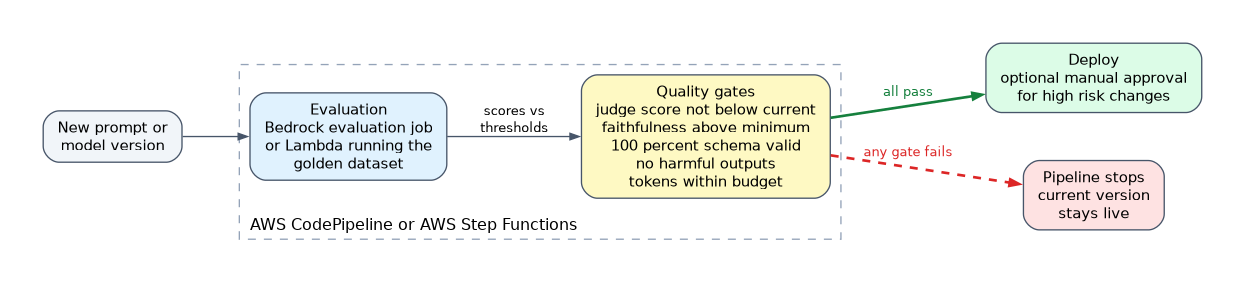 A quality gate is a pass or fail step in the deployment pipeline. AWS CodePipeline or AWS Step Functions can start an evaluation, for example a Bedrock evaluation job or a Lambda function that runs the golden dataset, then compare the scores with thresholds.
| Gate | Example threshold |
|---|---|
| Correctness or helpfulness | Average judge score not lower than the current version |
| Faithfulness for RAG | Above an agreed minimum |
| Format | 100 percent schema valid |
| Safety | No harmful outputs on the red team set |
| Cost | Tokens per request not above budget |
If any gate fails, the pipeline stops and the current version stays live. Manual approval can be added for high risk changes, but the scoring itself should be automatic.
In exam scenarios, "prevent regressions from reaching production with the LEAST manual effort" points to an automated evaluation step with thresholds inside the CI/CD pipeline.
Continuous evaluation in production
Offline tests cannot predict every live question. Continuous evaluation samples production requests and scores them on a schedule or as they arrive.
- Enable model invocation logging so prompts and responses reach CloudWatch Logs or Amazon S3.
- Score a sample with a judge model, or with AgentCore online evaluation for agents.
- Publish the scores as CloudWatch metrics and set CloudWatch alarms on drops.
Deployment validation during FM updates
When you move to a new model or prompt version, validate it in stages.
Synthetic user workflows replay scripted journeys, such as "ask a policy question, then a follow up". Amazon CloudWatch Synthetics canaries run scripts on a schedule against your endpoints, so a broken flow is caught before users report it.
AI-specific output validation checks for problems a normal health check misses:
| Check | How |
|---|---|
| Hallucination rate | Faithfulness scores against retrieved context, or Amazon Bedrock Guardrails contextual grounding checks |
| Semantic drift | Embed answers to a fixed probe set and compare with the previous version's answers |
| Response consistency | Same probe asked several times, answers compared for equivalent meaning |
| Format stability | Schema validation on structured outputs |
Combine these with a canary release. Send a small share of traffic to the new version, watch error, latency and quality metrics, and roll back automatically if an alarm fires.
Reporting to stakeholders
Different audiences need different views of the same data.
| Audience | What they need | Tool |
|---|---|---|
| Engineers | Latency, errors, throttles, token use per model | CloudWatch dashboards and alarms |
| Product owners | Quality trend, user ratings, task completion | Amazon QuickSight (now Amazon Quick Sight, part of Amazon Quick Suite) dashboards on data in S3 via Athena |
| Leadership | Cost per outcome, adoption, model comparison | Scheduled reports and comparison charts |
Model comparison visualizations put candidates side by side: quality score against cost per request, or quality against latency. The Bedrock evaluation console also shows a histogram of judge scores for each metric.
Automate reporting so it does not depend on someone exporting spreadsheets. Evaluation results already land in S3 and CloudWatch, so a scheduled query and dashboard refresh is enough.
Common mistakes
Running evaluations only before launch. Models, data and user behavior drift. Production needs continuous scoring with alarms.
Exact match regression tests. They fail on harmless rewording and hide real meaning changes. Compare meaning with a judge or embeddings.
Health checks that only test HTTP 200. A model can return 200 with a hallucinated or malformed answer. Validate content, not just availability.
One dashboard for everyone. Executives do not read token throttle graphs. Match the view to the decision the audience makes.
What to remember for the exam
- Golden dataset plus semantic scoring is the basis of regression testing for FM outputs.
- Quality gates are automated thresholds in the pipeline that stop a release.
- Continuous evaluation uses invocation logs, sampled judge scoring, CloudWatch metrics and alarms.
- CloudWatch Synthetics canaries run synthetic user workflows on a schedule.
- Hallucination checks use faithfulness metrics or Guardrails contextual grounding; drift checks compare embeddings of answers across versions.
- CloudWatch dashboards serve operations; QuickSight dashboards serve business stakeholders.
Check yourself
What makes a regression test suitable for FM output?
It uses a versioned golden dataset and compares meaning, format and safety against thresholds instead of exact text.
How do you detect semantic drift after a model upgrade?
Run a fixed probe set on both versions, embed the answers and compare similarity against an agreed limit.
Which AWS feature runs scripted user journeys against an endpoint on a schedule?
Amazon CloudWatch Synthetics canaries.
Topic 3 of 6 in Testing, Validation, and Troubleshooting
Test yourself on Testing, Validation, and Troubleshooting
The full AWS AIP-C01 question bank has 827 questions, with timed practice exams and an explanation for every answer.
This study guide is independent and is not affiliated with, endorsed by, or sponsored by AWS. Vendor names, certification names and exam codes are trademarks of their respective owners and are used for identification only.