Foundation Model Integration, Data Management, and Compliance · Topic 3 of 9
Flexible and Resilient Model Architectures
Switch FMs without code changes using API Gateway, Lambda and AWS AppConfig, and stay available with cross-Region inference and circuit breaker patterns.
- 6 min
- Includes a diagram
- API Gateway plus Lambda gives one stable interface; AWS AppConfig holds the model choice.
- AppConfig adds validators, gradual deployment and alarm based rollback for configuration.
- The Converse API reduces per provider request formatting.
What it is
New FMs arrive every few months, and prices, quotas and availability change. A flexible architecture lets you switch the model or provider by changing configuration, not by rewriting and redeploying code.
Resilience is the other half. When a model is throttled, unavailable in a Region or slow, the application should retry, route elsewhere or degrade gracefully instead of failing outright.
How it works
Abstraction layer for model switching
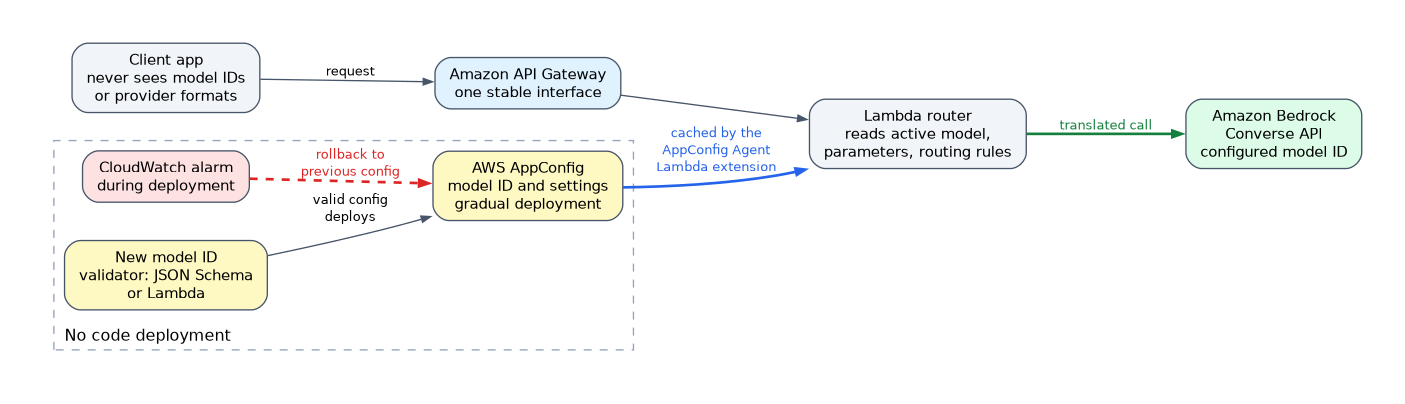 Put one stable interface in front of the models. Clients call Amazon API Gateway, and an AWS Lambda function translates the request into the call for whichever model is configured.
- The client never sees model IDs or provider request formats.
- The Lambda router reads the active model, parameters and routing rules from configuration.
- The Converse API in Amazon Bedrock uses one message format for many models, so changing the model ID is often the only change.
AWS AppConfig stores that configuration as feature flags or freeform configuration. You change the model ID in AppConfig, and the change rolls out without a code deployment.
| AppConfig feature | Why it matters for model switching |
|---|---|
| Validators | A JSON Schema or Lambda validator rejects a bad configuration before it deploys |
| Deployment strategies | Roll out a new model gradually over a set time |
| Rollback on CloudWatch alarms | An alarm during deployment reverts to the previous configuration |
| AWS AppConfig Agent Lambda extension | Caches configuration in the function, so each request does not call AppConfig |
"Switch models without code modifications" points to configuration outside the code, such as AWS AppConfig, read by a Lambda abstraction layer. Environment variables still need a function update, so they are a weaker answer.
Routing rules can also be smarter than one fixed model. Send simple requests to a small model and complex ones to a larger model. Amazon Bedrock Intelligent Prompt Routing does this automatically between models in the same family, predicting which model gives the needed quality at lower cost.
Cross-Region inference
Some FMs are offered in only a few Regions, and on demand capacity can throttle at peak. Amazon Bedrock cross-Region inference uses an inference profile that spreads requests across several Regions.
- You pass the inference profile ID instead of the model ID, for example an ID with a geographic prefix such as
us.oreu.. - Geographic profiles keep processing within a geography, such as the US or EU, which helps with data residency.
- Global profiles can route to any supported commercial Region for the most throughput.
- Some models are available in a Region only through an inference profile.
Choose a geographic profile when the scenario mentions residency rules; choose global when it stresses maximum availability and throughput with no residency limit.
Cross-Region model deployment is the self managed alternative. You deploy the model, such as a SageMaker AI endpoint, in two Regions and route with Amazon Route 53 health checks or application logic. It costs more but gives you full control.
Circuit breakers with AWS Step Functions
Retrying a failing model forever makes an outage worse. A circuit breaker stops calling a failing dependency for a while and uses a fallback instead.
In AWS Step Functions, the pattern uses these pieces:
- Retry on the task with IntervalSeconds, MaxAttempts, BackoffRate and jitter, for transient errors such as throttling.
- Catch to route to a fallback state when retries run out.
- A state store, often Amazon DynamoDB, that records failures and whether the circuit is open, so later executions skip the failing model until a timeout passes.
Graceful degradation
When the best option is unavailable, give a lesser but useful answer.
| Degradation step | Example |
|---|---|
| Fall back to another model | Larger model throttled, smaller model answers |
| Serve cached responses | Return a stored answer to a common question |
| Reduce features | Return retrieved documents without a generated summary |
| Queue for later | Accept the request and finish it asynchronously |
| Clear message | Tell the user the assistant is busy and offer a human channel |
How the exam asks about this
- "Switch from one Bedrock model to another without redeploying the application" -> Store the model ID in AWS AppConfig and read it from the Lambda router.
- "A model is only in us-east-1 and the app runs in us-west-2, with US data residency" -> Bedrock cross-Region inference with a US geographic inference profile.
- "Stop hammering a throttled model and use a backup model" -> Step Functions Retry with backoff, Catch to a fallback, circuit state in DynamoDB.
Common mistakes
Hard coding model IDs. Every change then needs a code release. Keep model choice in configuration.
Treating cross-Region inference as a residency risk by default. Geographic inference profiles keep processing inside the named geography. Read the profile type before rejecting it.
Retrying without backoff. Tight retry loops amplify throttling. Use exponential backoff with jitter and a retry limit.
No fallback path. A design with one model and no Catch path fails completely during a disruption.
A fallback model may produce different formats or quality. Test the fallback path with the same evaluation set, not just the primary model.
What to remember for the exam
- API Gateway plus Lambda gives one stable interface; AWS AppConfig holds the model choice.
- AppConfig adds validators, gradual deployment and alarm based rollback for configuration.
- The Converse API reduces per provider request formatting.
- Cross-Region inference uses inference profiles: geographic for residency, global for maximum throughput.
- Circuit breaker in Step Functions: Retry with backoff, Catch to fallback, state in DynamoDB.
- Graceful degradation: smaller model, cache, reduced features, queue, clear message.
Check yourself
How do you change the FM used by 20 Lambda functions without a deployment?
Store the model ID in AWS AppConfig and have the functions read it, ideally through the AppConfig Agent Lambda extension.
Which Bedrock feature helps when a model has limited Regional availability or throttles at peak?
Cross-Region inference through an inference profile, which routes requests to Regions with capacity.
What does a circuit breaker add beyond simple retries?
It records repeated failures and stops calling the failing model for a period, sending requests to a fallback instead.
Topic 3 of 9 in Foundation Model Integration, Data Management, and Compliance
Test yourself on Foundation Model Integration, Data Management, and Compliance
The full AWS AIP-C01 question bank has 827 questions, with timed practice exams and an explanation for every answer.
This study guide is independent and is not affiliated with, endorsed by, or sponsored by AWS. Vendor names, certification names and exam codes are trademarks of their respective owners and are used for identification only.