Security, Compliance and Governance · Topic 1 of 5
Securing AI with AWS Services
Secure AI systems on AWS with IAM roles and policies, encryption, Amazon Macie, AWS PrivateLink and a clear view of the shared responsibility model.
- 4 min
- Includes a diagram
- Under the shared responsibility model, AWS secures the cloud and the customer secures what it puts in the cloud.
- IAM roles and policies control access, and least privilege is the guiding rule.
- Use IAM roles for applications instead of hard coded keys.
What it is
Securing an AI system means protecting its data, its models, the access to them and the network paths between them. The same AWS security building blocks that protect other workloads also protect AI workloads.
The exam stays at the level of knowing which service does which job, and who is responsible for what.
How it works
Shared responsibility model
AWS and the customer split the work of security. AWS is responsible for the security of the cloud: the facilities, hardware and the managed service software. The customer is responsible for security in the cloud: who may access the service, how data is classified and encrypted, and how the application is built and configured.
With a managed service such as Amazon Bedrock, AWS runs more of the stack, so the customer's job is mostly identity, data and configuration. If you host your own model on a SageMaker AI endpoint, you take on more of the setup.
Identity and access with IAM
AWS Identity and Access Management (IAM) controls who can do what.
| Element | Role in AI security |
|---|---|
| IAM users and roles | Identities for people and for applications and services |
| IAM policies | Rules that allow or deny actions on resources |
| Permissions | The specific actions granted, such as invoking a model |
| Least privilege | Grant only what is needed for the task |
Applications should use IAM roles, not long lived keys stored in code. For example, a role for a chat application can be allowed to invoke one specific model and nothing else. Separate roles for development and production reduce the damage from a mistake.
Encryption
Encryption protects data if someone gets access to storage or intercepts traffic.
| Type | Protects | Typical AWS support |
|---|---|---|
| At rest | Stored data such as training data, models and knowledge bases | AWS Key Management Service (AWS KMS) keys, and encrypted Amazon S3 buckets |
| In transit | Data moving between systems | Transport Layer Security (TLS) on service endpoints |
With AWS KMS you can use your own keys to encrypt data and customised models, which gives you control over who can use the keys.
Amazon Macie
Amazon Macie finds sensitive data in Amazon S3 using machine learning and pattern matching. It can discover personal data, such as names and card numbers, before that data is used for training or retrieval. This helps you keep sensitive records out of AI datasets.
AWS PrivateLink
AWS PrivateLink gives private connectivity between your Amazon Virtual Private Cloud (VPC) and supported AWS services, so traffic does not cross the public internet. Interface VPC endpoints use PrivateLink, and they can be used to reach services such as Amazon Bedrock from a private network.
Logging and monitoring
Record who called what. AWS CloudTrail logs API calls, which helps with audits and investigations. Amazon CloudWatch collects logs and metrics, and Amazon Bedrock can log model invocations so you can review prompts and responses where policy allows.
Putting the controls together
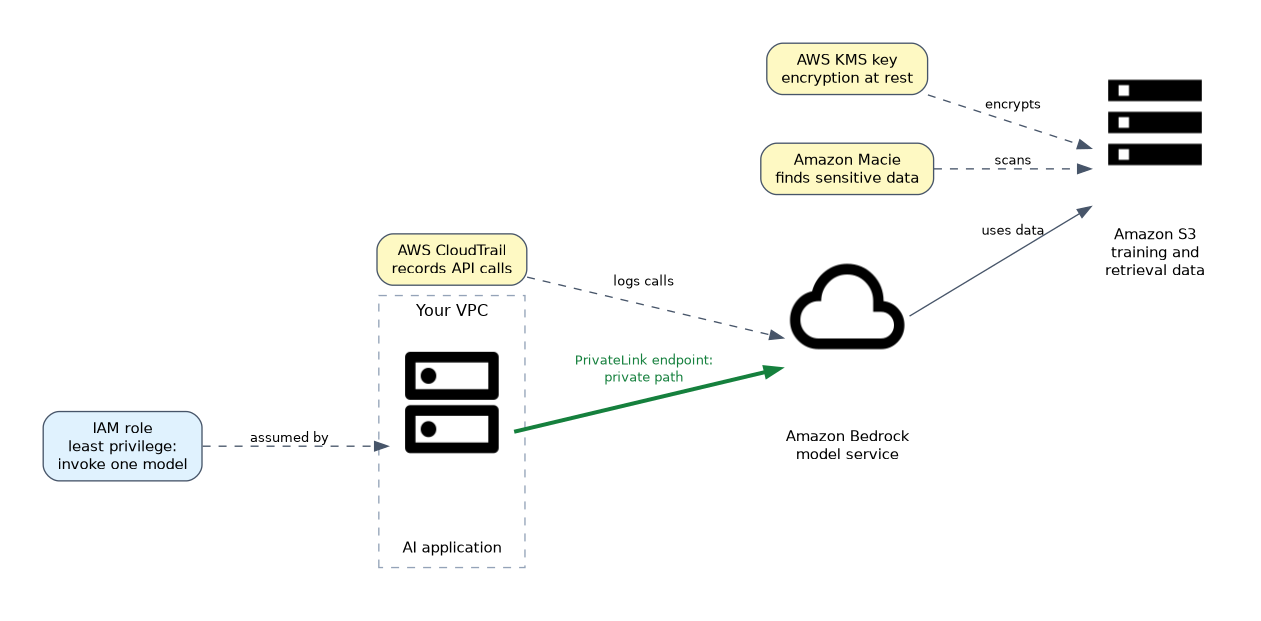
| Goal | Control |
|---|---|
| Limit who can call a model | IAM roles and least privilege policies |
| Protect stored data | Encryption at rest with AWS KMS |
| Protect traffic | TLS, and PrivateLink for private paths |
| Find sensitive data | Amazon Macie |
| Keep an audit trail | AWS CloudTrail and logs |
What to remember for the exam
- Under the shared responsibility model, AWS secures the cloud and the customer secures what it puts in the cloud.
- IAM roles and policies control access, and least privilege is the guiding rule.
- Use IAM roles for applications instead of hard coded keys.
- Encrypt data at rest, often with AWS KMS, and in transit with TLS.
- Amazon Macie discovers sensitive data in Amazon S3.
- AWS PrivateLink keeps traffic between your VPC and AWS services off the public internet.
- AWS CloudTrail records API activity for audit.
- Managed services shift more security work to AWS, but never all of it.
Private network path to a service means PrivateLink. Discover personal data in S3 means Macie. Who may call the model means IAM.
Common mistakes
Assuming AWS secures your data and permissions. Access control and data handling stay with the customer.
Giving broad permissions for convenience. Wide policies increase the harm of a leaked credential.
Putting access keys in application code. Use roles with temporary credentials.
Mixing up Macie and encryption. Macie finds sensitive data. Encryption protects it.
Thinking PrivateLink encrypts data. It provides a private path. Encryption is a separate control.
Check yourself
Under the shared responsibility model, who controls access to your data?
The customer, while AWS secures the underlying cloud infrastructure.
Which service discovers sensitive data stored in Amazon S3?
Amazon Macie.
Which feature lets a VPC reach Amazon Bedrock without using the public internet?
AWS PrivateLink through a VPC endpoint.
Topic 1 of 5 in Security, Compliance and Governance
Test yourself on Security, Compliance and Governance
The full AWS AIF-C01 question bank has 849 questions, with timed practice exams and an explanation for every answer.
This study guide is independent and is not affiliated with, endorsed by, or sponsored by AWS. Vendor names, certification names and exam codes are trademarks of their respective owners and are used for identification only.