Guidelines for Responsible AI · Topic 3 of 6
Detecting Bias and Trustworthiness
Use label quality analysis, human audits, subgroup analysis, SageMaker Clarify, Model Monitor and Amazon A2I to detect bias and check truthfulness.
- 4 min
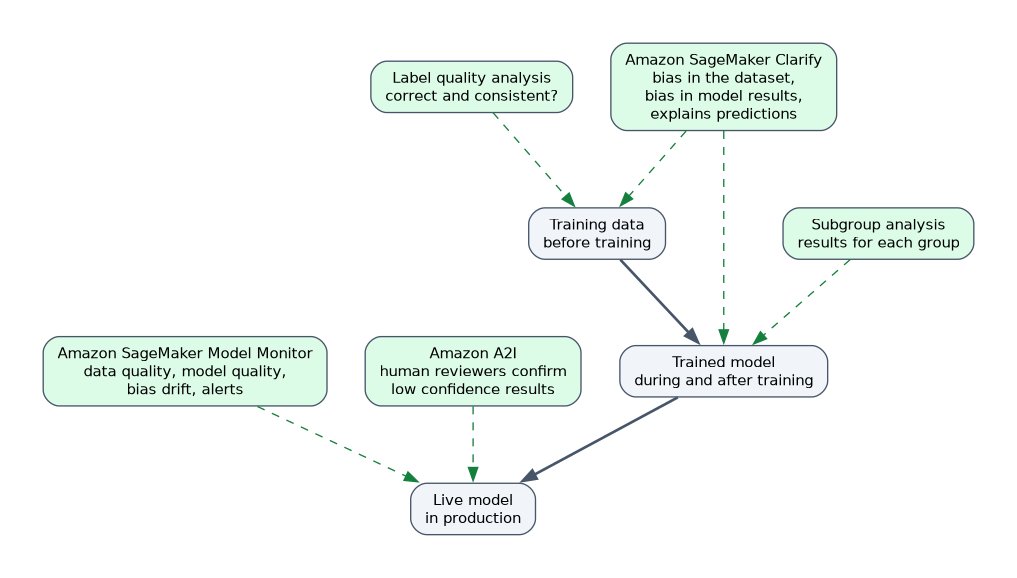
- Includes a diagram
- Label quality analysis checks that labels are correct and consistent.
- Human audits and subgroup analysis find bias that overall metrics hide.
- Amazon SageMaker Clarify detects bias in data and models and explains predictions.
What it is
Detecting bias and checking trustworthiness means measuring a model, not assuming it is fair. It uses both simple practices and AWS tools.
The aim is to find problems before launch and to keep watching after launch, because new data can bring new problems.
Each stage has its own checks.
How it works
Practices that need no special tool
| Practice | What it does |
|---|---|
| Label quality analysis | Checks whether labels are correct and consistent, and where labelers disagree |
| Human audits | Reviewers read samples of output for bias, errors and harm |
| Subgroup analysis | Measures results separately for each group, such as by age or region |
| Red teaming style testing | Tries tricky or hostile prompts to see how the system reacts |
| Feedback channels | Lets users report unfair or wrong answers |
Subgroup analysis is especially important. It compares accuracy or error rates across groups, so a gap shows up even when the overall figure looks good.
Amazon SageMaker Clarify
Amazon SageMaker Clarify detects bias in data and in models, and it explains model predictions. It can measure bias before training in the dataset, and after training in the model results.
It also shows which features influence predictions, which supports explainability. It also offers evaluation of foundation models.
Amazon SageMaker Model Monitor
Amazon SageMaker Model Monitor watches deployed models over time. It can track data quality, model quality, bias drift and feature attribution drift, and raise alerts when results move outside set limits. Bias that was low at launch can grow as live data changes, so monitoring catches it.
Amazon Augmented AI (Amazon A2I)
Amazon A2I brings humans into the loop. It routes predictions to human reviewers, for example when confidence is low or for a random sample. People confirm or correct results, which improves trust in sensitive decisions.
Amazon Bedrock Guardrails
Amazon Bedrock Guardrails apply checks to GenAI inputs and outputs. They can filter harmful categories, block certain topics, and mask or block sensitive personal data. They can also include a check that flags answers not supported by the supplied source text.
Truthfulness checks for GenAI
Truthfulness is the risk that a model states false things with confidence. Practical checks include:
- Ground answers in trusted documents with RAG, and show the sources.
- Compare answers with reference data on a test set.
- Use human review for important content.
- Ask users to rate or flag answers.
- Evaluate with benchmark sets and metrics, as in the evaluation page.
Choosing the tool
| Question | Tool or practice |
|---|---|
| Is the training data biased? | Clarify, subgroup analysis |
| Is the model biased after training? | Clarify, subgroup analysis |
| Has bias or quality drifted in production? | Model Monitor |
| Does a person need to confirm results? | Amazon A2I |
| Is the content harmful or off topic? | Amazon Bedrock Guardrails |
| Are labels reliable? | Label quality analysis, human audit |
Ongoing practice
Detection is not one time. Set thresholds, review alerts, keep records of tests and fix findings.
What to remember for the exam
- Label quality analysis checks that labels are correct and consistent.
- Human audits and subgroup analysis find bias that overall metrics hide.
- Amazon SageMaker Clarify detects bias in data and models and explains predictions.
- Amazon SageMaker Model Monitor tracks drift in data, quality and bias in production.
- Amazon A2I adds human review of predictions.
- Amazon Bedrock Guardrails filter harmful content and sensitive data.
- Truthfulness is supported by RAG, source citation, evaluation and human review.
- Detection continues after launch, not only before.
For a question about checking bias before and after training and explaining predictions, the answer is SageMaker Clarify. For watching a live model over time, it is Model Monitor.
Common mistakes
Checking bias once at launch. Live data changes, so keep monitoring.
Confusing Clarify and Model Monitor. Clarify measures bias and explains. Model Monitor tracks live quality and drift over time.
Believing A2I replaces the model. It adds human review where needed.
Relying on tools alone. Human audits and subgroup tests still matter.
Treating a fluent answer as a true one. Truthfulness needs checking against sources.
Check yourself
Which AWS service detects bias in data and models and explains predictions?
Amazon SageMaker Clarify.
What is subgroup analysis?
Measuring model results separately for each group, so gaps between groups become visible.
When is Amazon A2I useful?
When people need to review or confirm predictions, such as low confidence or sensitive cases.
Topic 3 of 6 in Guidelines for Responsible AI
Test yourself on Guidelines for Responsible AI
The full AWS AIF-C01 question bank has 849 questions, with timed practice exams and an explanation for every answer.
This study guide is independent and is not affiliated with, endorsed by, or sponsored by AWS. Vendor names, certification names and exam codes are trademarks of their respective owners and are used for identification only.