Fundamentals of GenAI · Topic 6 of 7
AWS Services for GenAI
Know the AWS services for building GenAI apps: Amazon Bedrock, SageMaker JumpStart, PartyRock, the Amazon Q family and the Titan and Nova models.
- 4 min
- Includes a diagram
- Amazon Bedrock is the fully managed service for foundation models from several providers through one API.
- Knowledge Bases supports RAG, Agents carry out multi step tasks, and Guardrails filter content.
- Amazon Titan and Amazon Nova are Amazon's own model families on Bedrock.
What it is
AWS offers several ways to build with GenAI, from ready assistants you simply use to platforms where you control the model. The exam asks you to pick the right one for a scenario.
The main choices are Amazon Bedrock, Amazon SageMaker AI (with JumpStart), PartyRock and the Amazon Q family.
The flow runs from least effort and control on the left to most on the right.
How it works
Amazon Bedrock
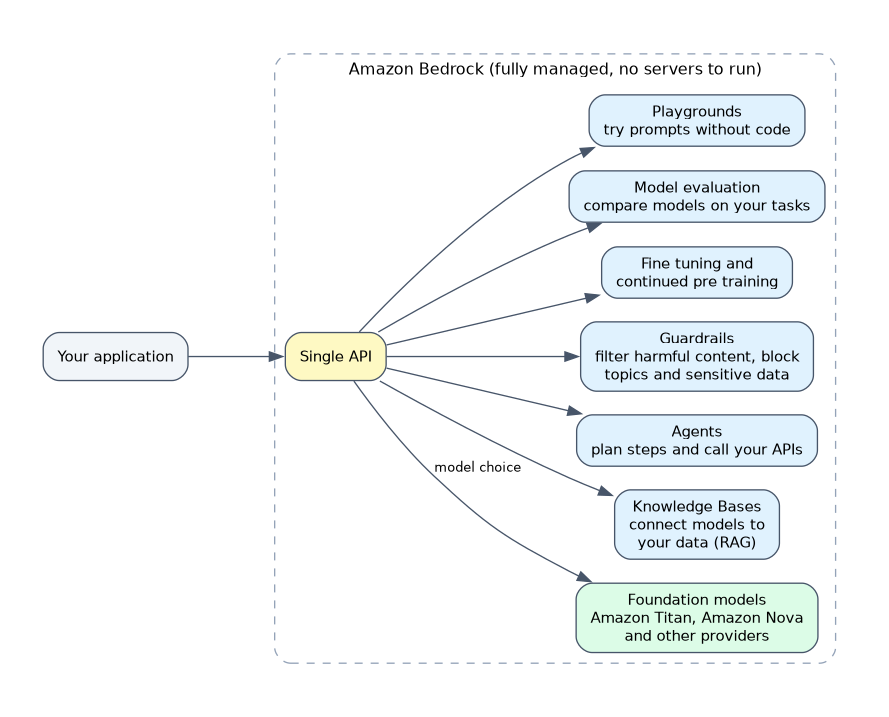 Amazon Bedrock is a fully managed service that gives access to foundation models from several providers through a single API. The providers include Amazon and other AI companies. You do not manage servers, and you can switch models without changing the whole application.
Key capabilities that the exam names:
| Capability | Purpose |
|---|---|
| Model choice | Try and compare models from different providers |
| Knowledge Bases | Connect models to your data for retrieval augmented generation (RAG) |
| Agents | Let a model plan steps and call your APIs to finish tasks |
| Guardrails | Filter harmful content and block topics or sensitive data |
| Fine tuning and continued pre training | Customise supported models with your data |
| Model evaluation | Compare models on your own tasks |
| Playgrounds | Try prompts in the console without code |
AWS states that your prompts and data are not used to train the base models shared with other customers, and your customised model stays private to your account. The feature names above were once written "Knowledge Bases for Amazon Bedrock", "Agents for Amazon Bedrock" and "Guardrails for Amazon Bedrock", and exam wording may still use those forms.
Amazon Titan and Amazon Nova
Amazon Titan and Amazon Nova are families of foundation models from Amazon that are available through Amazon Bedrock. Titan includes text, image and embedding models.
Nova includes models that understand text, images and video, plus models that generate images and video. Embedding models turn content into vectors for search and RAG.
Amazon SageMaker AI and JumpStart
Amazon SageMaker AI is the platform for building, training and hosting ML models with full control. SageMaker JumpStart is a hub inside it with pre trained foundation models and ready solutions. Choose it when you need more control over the model, training or hosting than a managed API gives.
PartyRock
PartyRock is a playground for building small GenAI apps without writing code, based on Amazon Bedrock. It is meant for learning and experiments, which makes it a good answer when a question asks about trying GenAI with no coding.
The Amazon Q family
Amazon Q is a family of GenAI assistants.
| Assistant | For whom | What it does |
|---|---|---|
| Amazon Q Business | Employees | Answers questions and takes actions using company data, respecting user permissions |
| Amazon Q Developer | Developers and builders | Helps write, explain, test and improve code, and with work on AWS |
Amazon Q is used when you want a ready assistant rather than building one from models.
Choosing quickly
| Need | Choice |
|---|---|
| A ready made assistant over company data | Amazon Q Business |
| Coding help | Amazon Q Developer |
| Build your own app on managed models | Amazon Bedrock |
| Chat over your data with RAG, no custom code | Bedrock Knowledge Bases |
| Block harmful content in an app | Amazon Bedrock Guardrails |
| Full control over a model and hosting | SageMaker AI |
| Quick no code experiment | PartyRock |
Other AWS AI services still apply
Task specific services, such as Amazon Transcribe, Amazon Translate and Amazon Textract, remain good choices for focused jobs. A GenAI model can work on their output.
What to remember for the exam
- Amazon Bedrock is the fully managed service for foundation models from several providers through one API.
- Knowledge Bases supports RAG, Agents carry out multi step tasks, and Guardrails filter content.
- Amazon Titan and Amazon Nova are Amazon's own model families on Bedrock.
- SageMaker JumpStart offers pre trained models when you need more control than Bedrock.
- PartyRock is a no code playground for building GenAI apps.
- Amazon Q Business is for employees using company data, and Amazon Q Developer is for coding.
- Pick a ready assistant for the least effort, Bedrock for managed building, and SageMaker AI for most control.
- Your data is not used to train the shared base models in Bedrock.
Fully managed access to several providers' models points to Amazon Bedrock. Full control over training and hosting points to SageMaker AI.
Common mistakes
Choosing SageMaker AI when Bedrock is enough. If a managed API model does the job, Bedrock needs far less work.
Confusing Amazon Q Business and Q Developer. One serves employees on company data, and the other serves developers.
Treating PartyRock as a production platform. It suits learning and prototypes.
Mixing up Knowledge Bases and Agents. Knowledge Bases supply data to the model. Agents let the model act on steps.
Thinking Guardrails train the model. They filter inputs and outputs at run time.
Check yourself
Which service gives managed access to foundation models from several providers?
Amazon Bedrock.
Which Bedrock feature connects a model to your company documents for RAG?
Amazon Bedrock Knowledge Bases.
Which Amazon Q assistant helps staff using company data?
Amazon Q Business.
Topic 6 of 7 in Fundamentals of GenAI
Test yourself on Fundamentals of GenAI
The full AWS AIF-C01 question bank has 849 questions, with timed practice exams and an explanation for every answer.
This study guide is independent and is not affiliated with, endorsed by, or sponsored by AWS. Vendor names, certification names and exam codes are trademarks of their respective owners and are used for identification only.